Case study
A farm's spray records, written once in the cab and ready to print when the auditor asks
Buckshot Clay Farms grows row crops on about 3,000 acres, most of it out of cell range. Its spray records lived in a notebook in the truck until somebody asked for them. This is the story of the night before one audit, spent typing, and of the day before the next one.
- Company
- Buckshot Clay Farms Row-crop farm
- Industry
- Farms and agriculture
- Location
- Northwest Mississippi
- Size
- 7 people, about 3,000 acres
Before and after
What the software changes
-
Before Spray records sit in a notebook in the truck until a buyer or an auditor asks
After The operator records each application on a phone in the cab, and it syncs back at the shop
-
Before Anything entered on a phone out of signal range is lost
After The job is loaded before the truck leaves and works with no signal
-
Before Nobody knows how much product is left in the chemical shed
After Product used comes off the chemical inventory
-
Before Getting records ready for an audit takes a night of typing
After Each application sits in its field's history, ready to print
The story
The business
Buckshot Clay Farms grows soybeans, corn and cotton on about 3,000 acres in northwest Mississippi. Seven people work there, four of them in the field. Most of the ground is out of cell range.
Earl, the owner, planned every application himself: which fields, which product, the rate and the tank mix. He wrote the day's plan on a sheet of paper and handed it to Trey, the sprayer operator, at the shop door. Trey wrote down what he had actually done in a notebook that lived in the truck. Rosa kept the office and the records, so when somebody asked for a spray record, she went out to the truck.
The problem
On a Tuesday night in July, Rosa sat in the office typing up Trey's notebook. Some of the farm's soybeans were grown under contract, and the buyer's auditor was coming at nine the next morning to read the spray records for those fields.
The notebook had been written on a steering wheel. One page had dried stuck to the next. An entry in June gave a field and a product and no wind. Another was dated two days after Earl's plan sheet said the field had been sprayed. At ten she called Trey, who remembered that rain had pushed it back. The notebook didn't say so.
Trey had tried to do better. That spring he had started entering each application into a spreadsheet on his phone. In the field there was no signal, the phone showed him a spinning circle, and when he got back to the shop two of the entries were gone. He went back to the notebook.
The chemical shed was no better known. The week before, Earl had planned a tank mix for a morning, and Trey had found the shed one jug short of it. The sprayer sat until noon while someone drove to town.
Rosa finished the binder after one in the morning. Earl didn't want software that told him how to farm, and the machines kept their own data. He wanted what Trey did in a field to be written down once, in the cab, signal or no signal.
What was built
PlankByte built a spray log that starts in the cab and ends in the audit binder.
Earl plans the day's applications: which fields, which product, the rate and the tank mix. The fields, the products and the plan download to Trey's phone before the truck leaves the shop, so nothing depends on finding a signal.
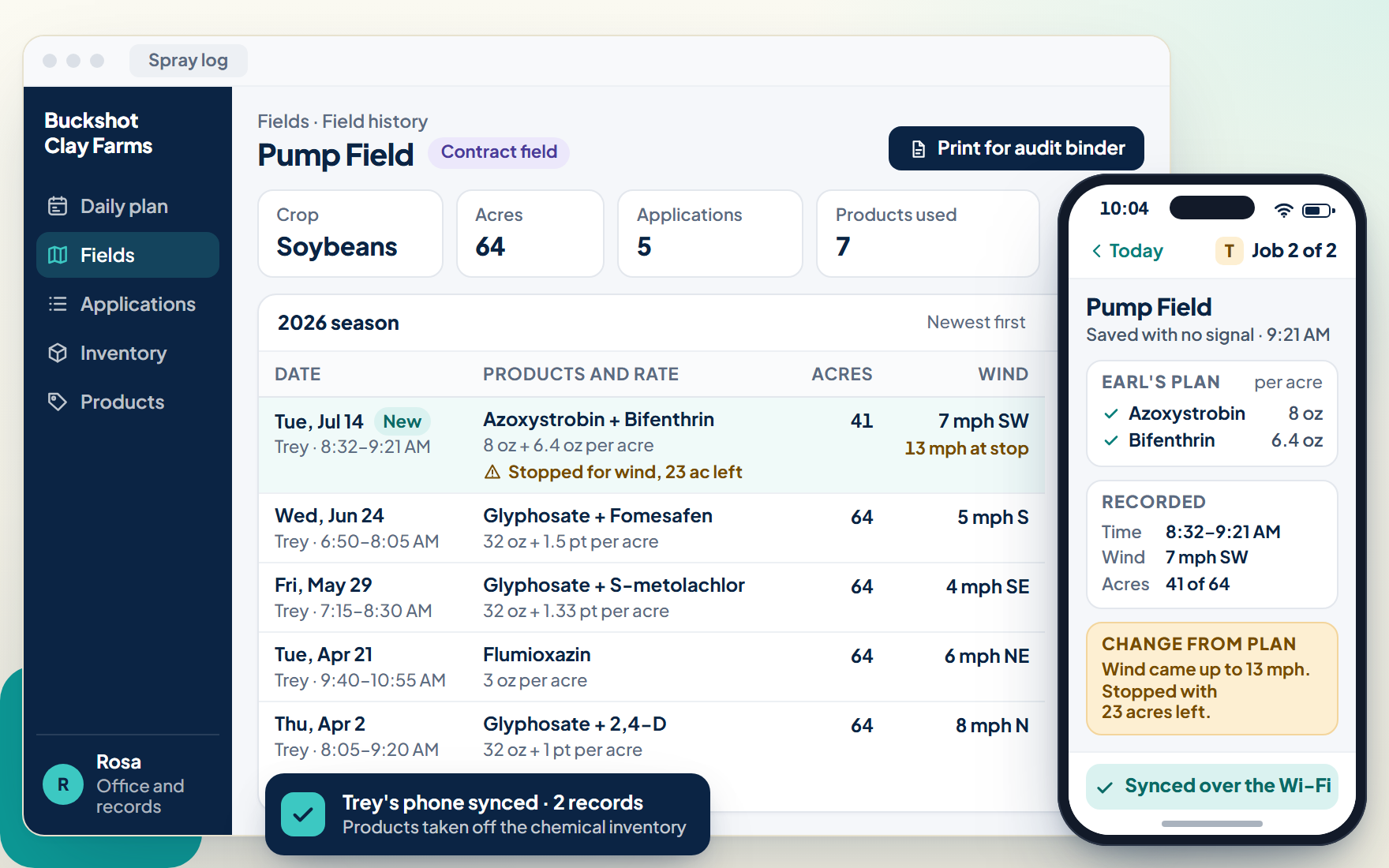
In the cab Trey opens the job with everything already loaded. He doesn't write the application out. When a field is finished he confirms what went on and records the start and end times, the wind, the acres covered and any change from the plan. The record saves on the phone.
The product he used comes off the chemical inventory. Back at the shop the record syncs over the Wi-Fi, and the count in the chemical shed is current, so Earl knows what is left before he places the next order.
Each application then sits in its field's history, by date, product and operator. Rosa prints a field's history for the audit binder, or sends it to a buyer who asks.
The first weeks
The farm started in February, before the first field was sprayed. Rosa entered every field under the name the farm used for it, and some of those were the names of the people who had sold the ground to Earl's father. She entered the products too.
The shed needed a starting count, and Earl and Rosa spent a Saturday making one, jug by jug. It was wrong in one place: jugs that were partly used had gone in as full ones. Earl counted those again.
Earl's own habits were slower to change. He had always changed the plan at the truck window, or over the radio. Now a change he called out was a change Trey had to note against the plan. And for the first weeks Trey parked where the shop's Wi-Fi didn't reach, so his records came in a day late, until he started carrying the phone inside.
A day now
On a Tuesday the following July, the auditor was due again the next morning.
Earl planned two fields before six, and the plan was on Trey's phone when he pulled out of the yard. Both fields were well out of range. On the second, the wind came up before he was done. He stopped, recorded the acres he had covered and noted the change from the plan.
When he got back to the shop, the records synced. Earl looked at the shed count before he called in the next order.
Rosa printed the history of each contract field for the binder, that morning's application included. She was home by six.
The notebook was still in the truck. Trey kept phone numbers in it.
PlankByte
Case study
Custom software for small businesses.
plankbyte.com/case-studies/agriculture-spray-log/
Contact: plankbyte.com/contact/