Case study
Extra work approved by text, so a repair shop's cars stop waiting on the lift for a callback
Saltbush Garage is an independent auto repair shop with six bays and two service writers. When a technician found extra work, the shop left a voicemail and the car waited on the lift. In this story the customer gets a photo, a price and a link by text instead, and the answer lands on the repair order.
- Company
- Saltbush Garage Independent auto repair
- Industry
- Auto repair shops
- Location
- Southern New Mexico
- Size
- 12 employees, 6 bays
Before and after
What the software changes
-
Before The shop leaves a voicemail about a leaking water pump, and the car sits on the lift until the customer calls back
After The customer gets a text with the photo, the price and a link to approve
-
Before Customers call all day to ask whether their car is ready
After A ready-for-pickup text goes out with the total when the technician closes the job
-
Before Work a customer declined is noted on a paper repair order and forgotten in a file drawer
After Declined work stays on the vehicle's history and comes back as a reminder before the next visit
-
Before Finding last spring's repair order means going through a file drawer
After Every past visit to the shop is on the same screen as the open repair order
The story
The business
Saltbush Garage is an independent auto repair shop in southern New Mexico. Ray owns it. Twelve people work there, in six bays and at a front counter where Carmen is one of two service writers.
The shop had always run on paper. A repair order was written by hand at the counter and went out to the bay on a clipboard. When a technician found more than the customer had come in for, a service writer picked up the phone. A paid order went into a file drawer in the back office, under its month.
The problem
On a Thursday in October, a sedan sat on the lift in bay four with its oil change done and its splash shield still on the floor. Deshawn, the technician, had found coolant dripping from the water pump. Carmen worked out a price, called the customer and left a voicemail. Most customers called right back, so the car stayed up. This one taught school, and her phone was in a desk drawer until three.
By noon a man who had been promised an oil change while he waited was still waiting for a lift. The phone kept ringing with people asking whether their cars were done. One caller said the shop had done his brakes last spring and they were squealing again. Finding that order took Carmen twenty minutes in the file drawers.
The teacher called back at twenty to four and said yes. The parts store's last delivery had left at three. The sedan spent the night on the lift, and she found a ride home.
She also said she thought somebody had mentioned the pump before. After closing, Ray went through the drawers himself. Her order from June had a note on it: the pump was seeping, and the customer wanted to wait. Nobody had looked at it since.
Ray didn't want a machine doing Carmen's job. She would still price the work and decide what to send. He wanted a customer to see what Deshawn saw and answer without a phone call, and a note like that one kept somewhere other than a drawer. It also had to be quicker than a clipboard.
What was built
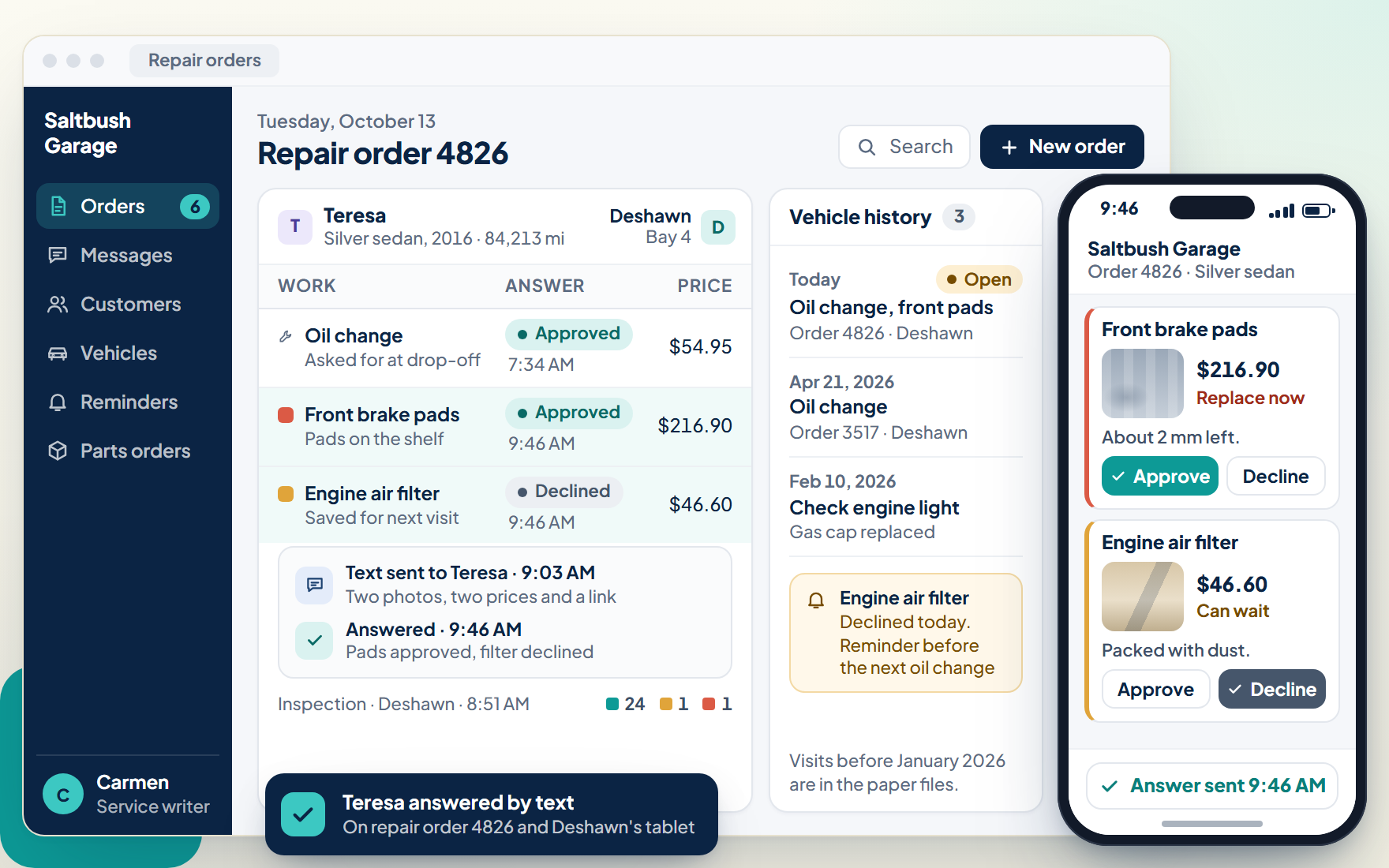
PlankByte built a repair order that Carmen and Deshawn both work on, one at the counter and one in the bay, and a way for the customer to approve extra work by text.
Deshawn goes through the inspection on a tablet and marks each item green, yellow or red. A leaking pump gets a red mark, a note and a photo. The photo takes one tap.
Carmen adds the parts and the labor and sends the customer a text with the photo, the price and a link. The customer approves or declines each line from a phone. The answer lands on the repair order with the time it came in, and Deshawn sees it without walking up front. Carmen orders any part that isn't on the shelf.
A line the customer declines stays on the car's history and comes back as a reminder before the next visit. Every earlier visit is on the same screen as the open order.
When Deshawn closes the job, the customer gets a text that the car is ready, with the total.
The first weeks
The shop switched over in the slow weeks after the holidays. Nobody typed in the old paper orders. A car's history began with its first visit after the switch, so for months Carmen still went to the drawers for anything older.
The hard part for Carmen was not calling. For weeks she sent the text and then phoned anyway, to say she had sent it. A few customers never opened the link, and she still called them.
Deshawn's first photos were too dark, or too close to tell what the part was. One customer called to ask what she was looking at. He learned to step back and to write one plain line under each picture.
A day now
The next fall the teacher's sedan was back in bay four for an oil change. Deshawn found the front brake pads nearly gone and an air filter packed with dust. He marked the pads red and the filter yellow and photographed both.
Carmen priced both and sent the text. The teacher read it between classes, approved the pads and declined the filter. Her answer was on the repair order before ten.
The pads were on the shelf. When Deshawn closed the job, the teacher got a text that the car was ready, with the total.
When a caller asked about his brakes, Carmen read him the date from his truck's history.
The filter stayed on the sedan's history, to come back as a reminder before her next oil change. When Ray locked up, the lift in bay four was down and empty.
PlankByte
Case study
Custom software for small businesses.
plankbyte.com/case-studies/auto-repair-text-approvals/
Contact: plankbyte.com/contact/