Case study
From paper inspection forms to scored reports a cleaning company's clients see the same day
Nightloom Building Services cleans about forty office buildings and schools at night. It learned that one of them had been missed when the client called the next morning, and its inspections were on paper forms that no client ever saw. The story starts with that phone call and ends with an inspection app, a site check-in and a report the client can open.
- Company
- Nightloom Building Services Night cleaning of office buildings and schools
- Industry
- Commercial cleaning companies
- Location
- Western Washington
- Size
- 180 employees, about 40 buildings
Before and after
What the software changes
-
Before A cleaner doesn't show up, and the company hears about it from the client the next morning
After Cleaners check in at the site, and a missed check-in alerts the supervisor that night
-
Before Each building's scope is in a binder at the office
After The inspection checklist for a building comes from that client's contract
-
Before Inspections are on paper, so nobody can show a client what was checked
After The client receives a scored report with photos the same day
-
Before A problem found on an inspection depends on someone passing it on
After It becomes a task for whoever cleans there the next night
The story
The business
Nightloom Building Services cleans office buildings and schools in western Washington, at night, after everyone else has gone home. It has about 180 employees, spread over about forty buildings.
Gloria, the owner, can no longer walk every building herself. Devon, the night supervisor, drives between them with a ring of keys. Hanh, the inspector, visits each one in turn and grades the work. The company ran on a schedule spreadsheet, a group text and a binder in the office that held every client's contract. Hanh inspected on a paper form, the same one for every building.
The problem
At twenty to eight on a Tuesday morning in February, the phone on Gloria's desk rang. It was the manager of a three-story office building. The trash cans were full, the break room was as his people had left it, and he wanted to know whether anyone had been in the building at all.
Nobody had. The cleaner who worked there had written to the group text the night before that her car wouldn't start. Her message sat between a question about vacuum bags and a photo of a locked supply closet. Devon was across the county, letting a floor crew into a school gym, and never scrolled back that far.
Gloria sent two people over before lunch. Then the manager asked when the building had last been inspected, and what had been found. Hanh had been there the week before, and her form was in a box at the office. She had marked a streaked mirror in a second-floor restroom and texted Devon, and the note had never reached the cleaner. The form had no line for the conference-room glass, which the contract said was cleaned every week. That page was in the binder.
Gloria had nothing to send him. She wanted to know at night that a building was empty, not the next morning, and to show a client what had been checked. She did not want anything her cleaners would need a class to use. Many read Spanish more easily than English, and plenty carried old phones.
What was built
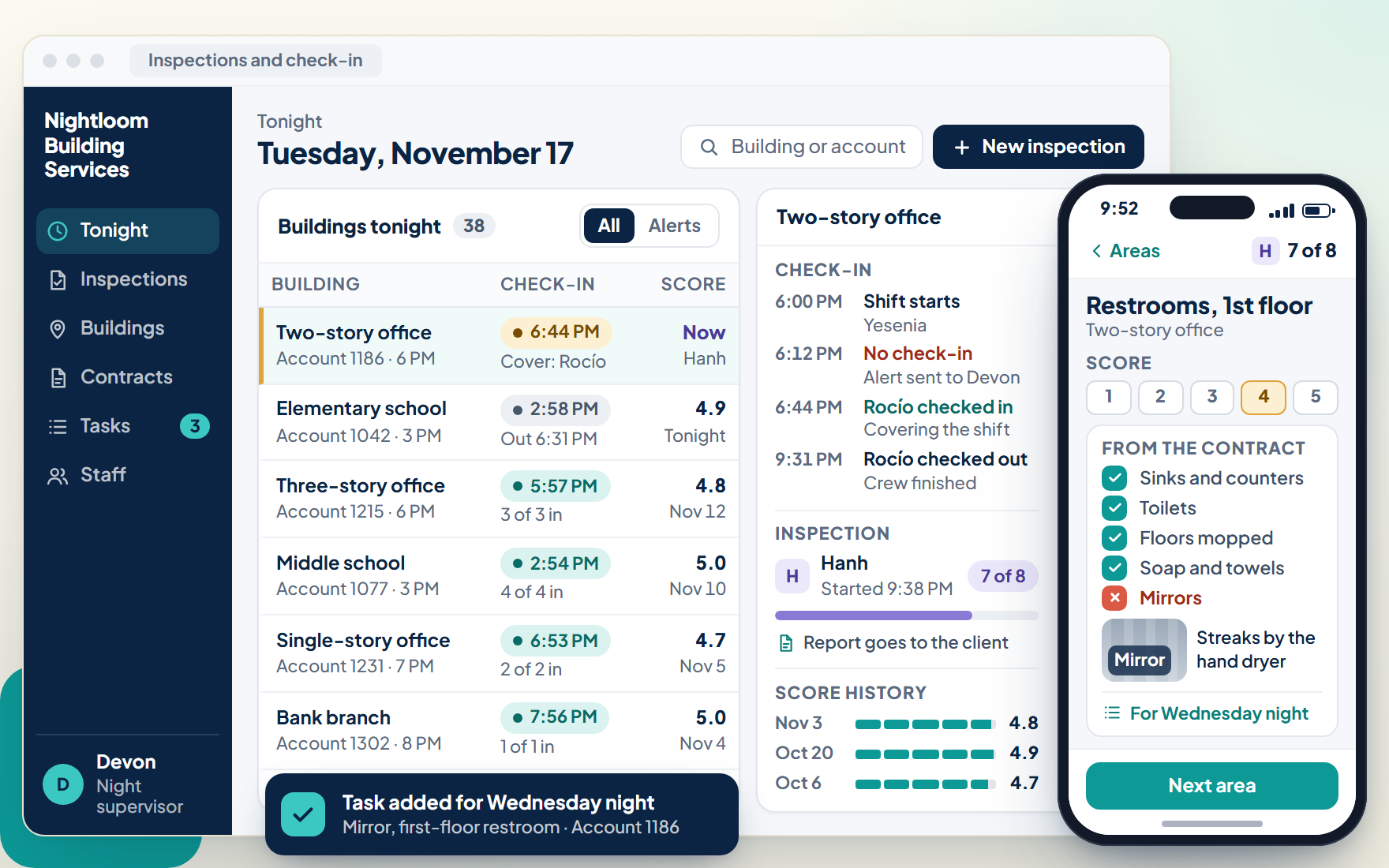
PlankByte built an inspection app that starts from each client's contract, and a site check-in for the cleaners.
Every building's contract is on file: the areas, how often each is cleaned and any special instructions. The building's checklist is made from it, so the conference-room glass is on the list wherever the contract includes it.
Hanh opens the inspection on her phone when the evening crew has finished. She scores each area as she walks it, and anything that fails gets a photo and a note. When she finishes, the client receives a report with the scores and photos, and the score joins the building's history, where Gloria can see whether a site is getting better or worse.
What fails no longer waits on a text. It goes onto the next night's list for that building, which the cleaner sees on a screen with a few large buttons, in English or Spanish. Devon can see when it is done.
The check-in is on the same screen. A cleaner taps it on arriving. If nobody has checked in soon after a shift starts, Devon gets an alert and can send someone to cover.
The first weeks
Gloria and Hanh typed the binder in one building at a time. A few contracts had been changed over the years by a phone call, and the binder had never caught up. Gloria called those clients and settled the scope before a checklist was made from it.
The cleaners needed little teaching and a lot of reminding. For the first weeks Devon's phone went off for buildings where the cleaner was already inside, vacuuming, and had not tapped the button. He called each one.
Gloria had worried about sending a client a report with a failed area on it. The first went out in the second week: a break room floor, with a photo. The next report for that building showed the same floor, passed.
A day now
On a wet Tuesday the following November, a cleaner did not arrive at a two-story office building. Her shift started at six. A little after six, Devon's phone showed the building with nobody checked in. He called her, and she was still waiting for a bus. Then he called a cleaner who was finishing at a school nearby, and met her at the door with the key.
Hanh inspected the building later that night. Everything passed but a mirror in a first-floor restroom, which got a photo and a note. The report reached the client before she had started her car.
At twenty to eight the next morning, the phone on Gloria's desk rang. It was a supplier, asking where to leave a pallet of paper towels.
That night the mirror was first on the cleaner's list. Devon saw it marked done a little after seven.
PlankByte
Case study
Custom software for small businesses.
plankbyte.com/case-studies/commercial-cleaning-site-inspections/
Contact: plankbyte.com/contact/