Case study
A commercial builder's daily log that shows where each job's costs stand before the month closes
Sillplate Commercial Builders is a general contractor with five or six commercial jobs going at a time. Its daily logs were text messages, and its cost reports came at month end, after the money was spent. The story follows two weeks of rock that nobody counted, and the daily log that now puts each day's hours on the job's cost report.
- Company
- Sillplate Commercial Builders Commercial general contracting
- Industry
- Construction companies
- Location
- Middle Tennessee
- Size
- 48 employees, 5 or 6 jobs at a time
Before and after
What the software changes
-
Before A job is found to be over budget at month end, once accounting has caught up
After Crew hours and approved bills post to their cost codes during the week, beside the budget and the committed cost
-
Before The daily log is a text thread and photos on the superintendent's phone
After The superintendent files the log from a phone at the end of the day, with the crew's hours by cost code
-
Before Friday afternoons go to chasing insurance certificates and lien waivers
After A sub whose insurance is about to expire is flagged before their next pay application is approved
-
Before The owner calls every week to ask where things stand
After The owner's progress page shows the photos and milestones the project manager chose
The story
The business
Sillplate Commercial Builders is a commercial general contractor in middle Tennessee, with forty-eight employees and five or six jobs going at a time. Subcontractors do most of the work, and the company's own crew does the concrete. Grace is the president.
For years each job lived in four places. The drawings and the schedule were in project software. The money was in the accounting software, where the bookkeeper coded bills and timesheets as she got to them. The subs' insurance certificates were in a spreadsheet. The daily log was whatever Walt, a superintendent, texted to Andre, his project manager, before he drove home.
The problem
On the first Friday of November, the bookkeeper closed October and printed the cost reports. On a new showroom for an equipment dealer, the excavation code had run well past its budget. The footings had been poured weeks before.
Grace called Walt. He told her the excavator had hit limestone on the second day of digging, and the company crew had spent most of two weeks breaking rock with a rented hydraulic hammer. The hours were on paper timesheets, and the bill for the hammer came weeks after it went back. Asked which days the crew was on rock, Walt scrolled through his texts and guessed.
Andre had seen Walt's photos of the ledge, but not the hours. That first week he could still have brought in a bigger machine, or walked the trench with the owner while the rock was showing. Now there was nothing left to decide.
He spent the rest of that Friday emailing subs for lien waivers and current insurance certificates, so their pay applications could be approved. The drywall sub's certificate had expired in mid-October, with their crew on site the whole time. At four the showroom's owner made his weekly call to ask where things stood, and Andre pieced an answer together from Walt's texts.
Grace didn't want new accounting software. The books were right, just a month late. And she wasn't going to ask Walt for an hour of paperwork every night. She wanted the month-end report during the month, from the log he was already sending.
What was built
PlankByte built a daily log that feeds each job's cost report.
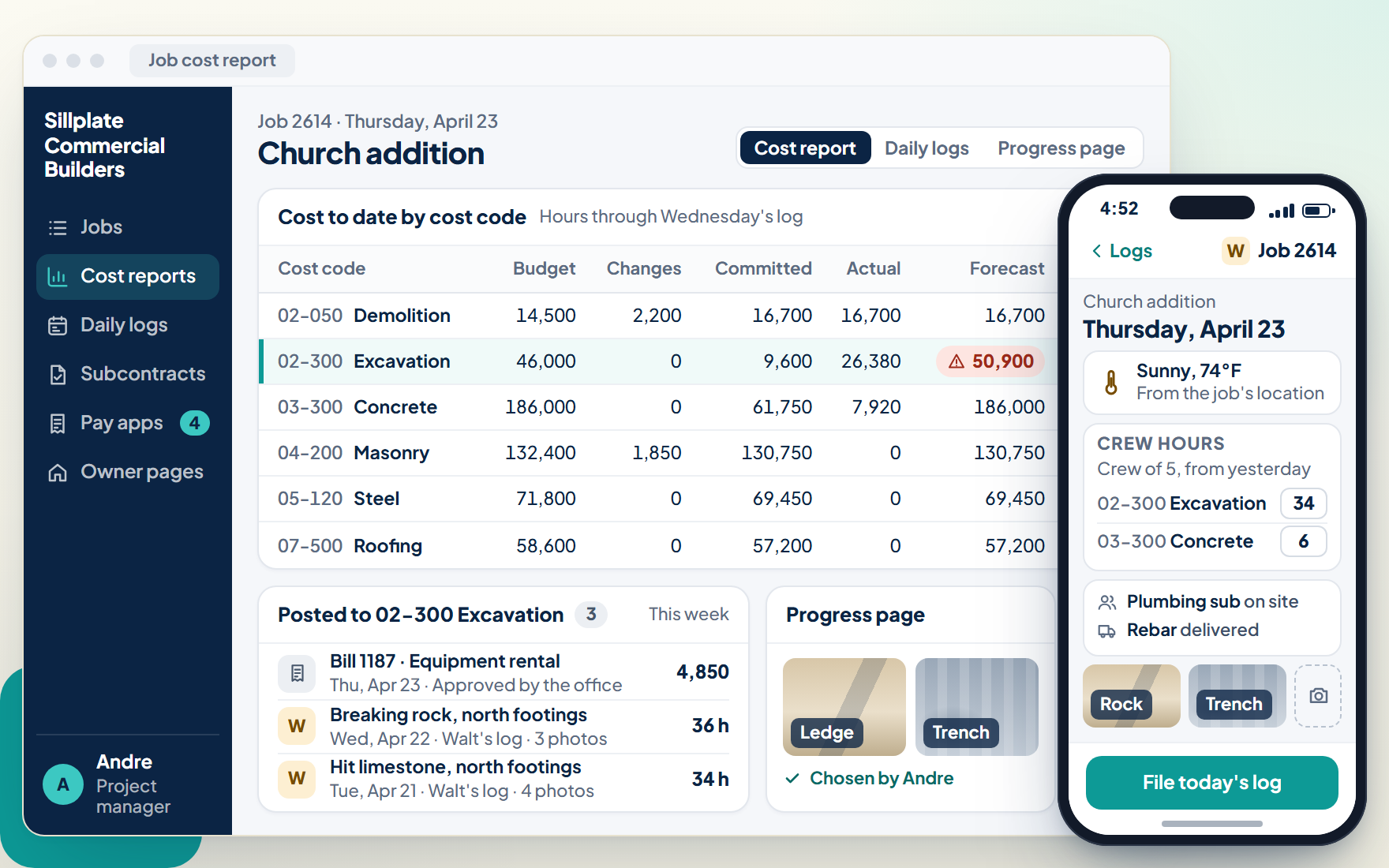
At the end of the day Walt files the log from his phone before he leaves the site. Yesterday's crew list is already there, and the weather fills in from the job's location. He marks which subs were on site, puts the crew's hours against their cost codes, notes deliveries and inspections, and adds photos straight from the camera.
Those hours post to their cost codes, and so do the bills the office approves that week. When Andre opens a job, each code shows its budget, approved changes, committed cost, actual cost and a forecast of where it will land. Grace reads the same report.
Before a sub's pay application is approved, the sub's insurance, lien waiver and contract are checked, and anything missing is flagged. A certificate about to expire is flagged ahead of the next pay application.
Each job has a progress page for its owner. Andre chooses which photos and milestones go on it, and the page keeps itself current.
The first weeks
Sillplate started with the two jobs that were just breaking ground. Their budgets came over by cost code, with the subcontracts and purchase orders already signed.
The subs' certificate dates came out of the spreadsheet, and many of them were old. On the first morning a long list of subs came up flagged, and Andre spent a week on the phone getting current certificates.
Walt had never picked a cost code, and for a few weeks some of his hours landed on the wrong ones. He also kept texting photos, and Andre answered each one by asking him to put it in the log.
A day now
One Tuesday the next April, on a church addition, the excavator hit limestone again.
Walt put the crew's hours on the excavation code in that night's log, with photos of the ledge. By Thursday the code's forecast had passed its budget, with most of the footings still to dig. Andre drove out, walked the trench with the owner, and had a bigger machine on site by Monday.
The code still ran over. But when the bookkeeper closed the month and printed the cost reports, Grace found nothing in that one she hadn't already read.
That Friday Andre approved the pay applications before lunch. The roofer, flagged on Monday with insurance about to expire, had sent a new certificate by Wednesday. The owner didn't call. The photos of the rock were on the progress page, where Andre had put them.
Walt filed Friday's log from the truck and drove home.
PlankByte
Case study
Custom software for small businesses.
plankbyte.com/case-studies/construction-daily-log/
Contact: plankbyte.com/contact/