Case study
An equipment rental yard where the counter, the yard and billing all look at the same machine
Tumbleyard Equipment Rentals keeps about 150 machines in one yard, with three people at the counter. Reservations lived in a spiral book, and every return started with a calculator. Then one Monday two customers arrived for the same mini excavator, and Pete, the owner, decided that the counter, the yard and billing had to work from the same screen.
- Company
- Tumbleyard Equipment Rentals Construction equipment rental
- Industry
- Equipment rental businesses
- Location
- California's Central Valley
- Size
- 15 employees, about 150 machines
Before and after
What the software changes
-
Before Two people at the counter promise the same machine
After The counter sees which units are free, due back or in the shop on those days, and a promised unit can't be booked again
-
Before Knowing what is out means a look at the key rack and a walk around the yard
After Every unit shows on one screen as ready, on rent or down for repair
-
Before Each return means a calculator: day or week rate, meter hours, fuel, cleaning
After Meter, fuel and condition are entered at check-in, and the invoice is worked out from them
-
Before An off-rent call is written on a note that may never reach billing
After Calling a machine off rent schedules the pickup and stops the billing
The story
The business
Tumbleyard Equipment Rentals rents construction equipment in California's Central Valley. Pete, the owner, keeps about 150 machines in the yard: compactors and trenchers, skid steers, mini excavators and boom lifts. Most of his customers are contractors.
Three people work the counter, and Lorena, the counter manager, has been there longest. Gus, the yard mechanic, checks machines in, services them and parks them on the ready line. Reservations had always gone in a spiral book beside the phones. To learn what was out, what was due back and what was in the shop, somebody looked at the key rack and then walked the yard.
The problem
On a Monday in April, two customers came for the same mini excavator. A landscaper had reserved it the week before, and Lorena had written it in the book. On Friday a concrete contractor called for one too. The book was at the far end of the counter, so the person who answered wrote his name on a pad and told him yes. On Monday the contractor was at the gate with his trailer at half past six, and the machine was chained down on it when the landscaper pulled in twenty minutes later.
Lorena went looking for another. The key rack said a second one was in. She walked the yard and found it in Gus's shop with a hydraulic hose off. The landscaper left with an empty trailer.
By then the weekend's returns were lined up. Each one meant the rate sheet and a calculator: day rate or week rate, extra hours on the meter, fuel, cleaning, and sometimes a dent nobody could say was new.
That afternoon a contractor called about his bill. He had called a boom lift off rent more than a week before, and the note about it had never reached billing. Pete issued the credit and made the apology himself. It was not the first call-off the office had lost.
Pete had no wish to change his rates, or the way the yard ran, to suit a program. He wanted the counter, the yard and billing to be looking at the same machine.
What was built
PlankByte built one program for the counter, the yard and the delivery trucks. It books a machine, gets the contract signed and works out the bill.
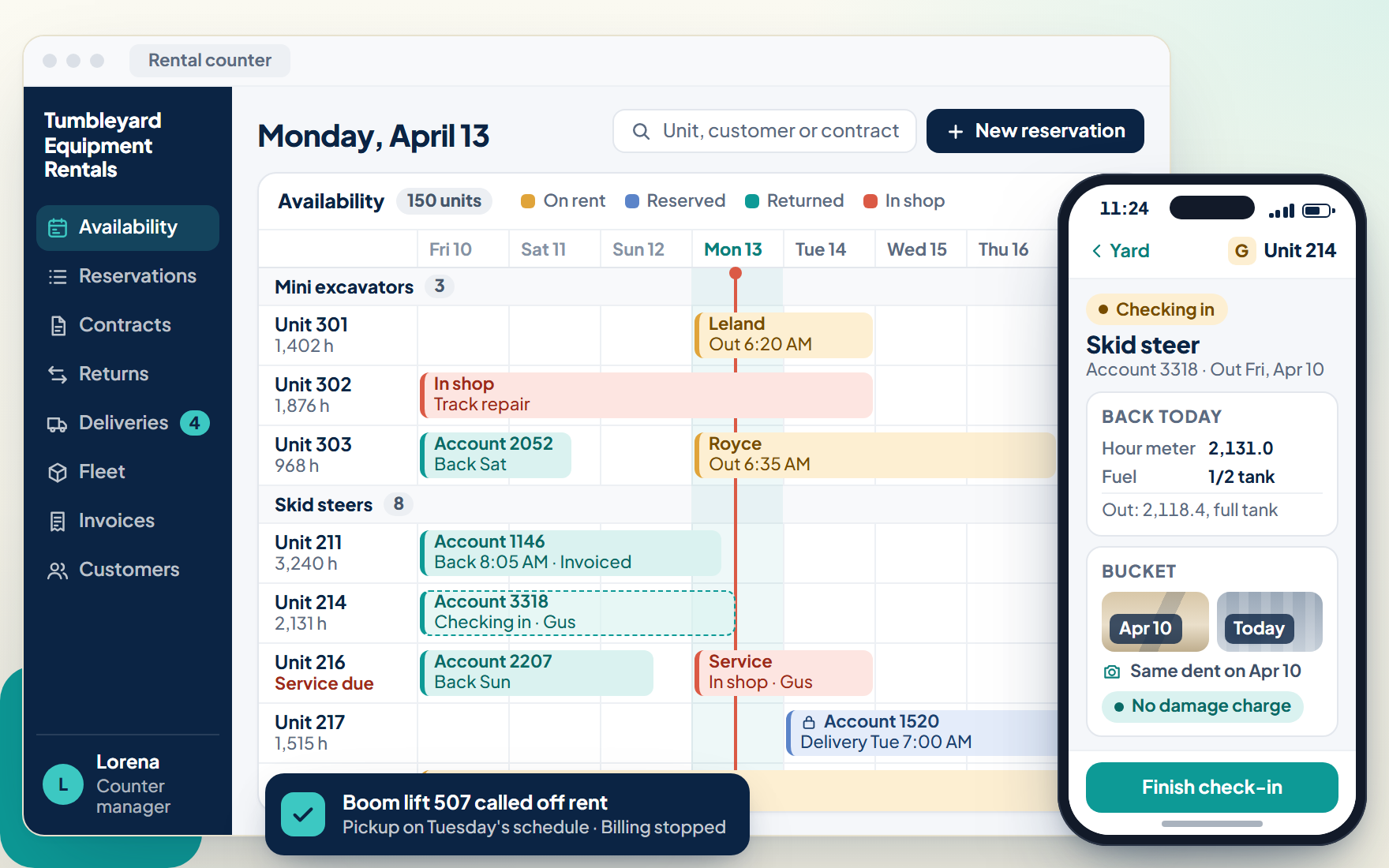
When a contractor calls for a mini excavator, Lorena opens that category for the days he wants. Every unit is there with its reservations, the day it is due back and whether it is in the shop. She books one that will be in the yard and schedules the delivery. A unit already promised for those days can't be booked again.
The contract fills itself in from the reservation. The customer signs on a tablet, and the deposit is recorded on the same screen. At drop-off the driver enters the hour meter and takes photos.
When a customer calls a machine off rent, whoever takes the call marks it. The pickup goes on the schedule and the billing stops.
Back in the yard, Gus finds the unit on his phone and enters its meter, fuel and condition. The invoice is worked out from that: Pete's rates, the extra hours, fuel, cleaning and damage. A unit due for service stays off the ready line until Gus has done it.
The first weeks
The move came in January, when rain keeps much of the fleet at home. Lorena and Gus walked the yard once more, with a tablet, and entered every machine: serial number, hour meter, attachments. Pete's rates went in the way he charged them. The open reservations were copied out of the book.
The ready line took longest. Gus had always hung a key on the rack when a machine was ready. Now it was not ready until he marked it on his phone, and for a few weeks Lorena kept calling the shop about machines she could see through the window.
A day now
On a Monday the following April, two customers wanted a mini excavator for the same morning. When the second called on Friday, the counter saw one unit promised, one in the shop and one due back on Saturday, and booked him the third. Both trailers left loaded.
The weekend's returns came through the gate. Gus entered meter, fuel and condition at each machine, and the invoice was on Lorena's screen when the customer reached the counter. One skid steer came back with a dent in its bucket. The photos from the day it went out showed the same dent, and nobody was charged.
Before noon a contractor called a boom lift off rent. Lorena marked it. The pickup went on Tuesday's schedule and the lift stopped billing.
Nobody walked the yard to find out what was in it. Gus was out there anyway, bringing in a skid steer that was due for service.
PlankByte
Case study
Custom software for small businesses.
plankbyte.com/case-studies/equipment-rental-counter/
Contact: plankbyte.com/contact/