Case study
A trade show moves its exhibitors out of email threads and its door off a printed list
Fairlight Expositions organizes a regional trade show with about 150 exhibitors. Their contracts and payments sat in email threads, booths were promised by phone, and the door ran on a printed list. One spring the line reached the parking lot. By the next show the exhibitors had a portal and the door had a scanning app.
- Company
- Fairlight Expositions Organizer of a regional trade show
- Industry
- Event management
- Location
- Northern Utah
- Size
- 17 employees, about 150 exhibitors a show
Before and after
What the software changes
-
Before Exhibitor contracts, insurance certificates and payments are spread across email threads
After Each exhibitor has one file in the portal: contract, certificate, payments and orders for power or furniture
-
Before Booths are promised by phone and marked in pencil on a floor plan
After Exhibitors pick an open booth on the floor plan, and it is held while they pay
-
Before Volunteers look names up on a printed list while the line grows
After Staff and volunteers scan QR tickets with their own phones, and badges print at check-in
-
Before Attendance at each session is a guess
After Reports show attendance by session
The story
The business
Fairlight Expositions puts on one trade show a year: two days each spring in a rented exhibition hall in northern Utah, for the region's cabinet shops, woodworking shops and furniture makers. About 150 exhibitors take booths, from machinery dealers with saws on flatbeds to a hardware supplier with one folding table. A few thousand people walk the floor.
Stephanie is the show director. Amir runs exhibitor services, which for years meant an inbox, a spreadsheet and a floor plan marked up in pencil. Kelly leads registration. Attendees signed up through a form on the show's website, and the week of the show Kelly printed the list.
The problem
On the first morning of the spring show the doors opened at nine, and by a quarter past the line ran out of the lobby and into the parking lot. Inside, six volunteers ran their fingers down printed lists. A shop owner had signed up eleven employees the night before. None of them were on the pages, and Kelly wrote their badges by hand.
On the floor, Amir had two exhibitors standing in one booth. He had promised it to each of them by phone, months apart. Three aisles over, a wood finish supplier was setting up with no certificate of insurance that Amir could find, so he stood in the aisle and searched his email.
A machinery dealer was still leveling a panel saw. Almost every truck had reached the dock at the same hour the afternoon before, and his had waited until dark for the forklift.
The week after, a speaker asked Stephanie how many people had come to his session. She did not know. Nobody had counted, and it had started while half the line was still outside.
That settled it. She did not want a different show. She wanted each exhibitor's paperwork in one place, a floor plan that could not promise a booth twice, and a door that did not run on paper.
What was built
PlankByte built an exhibitor portal and a scanning app for the show.
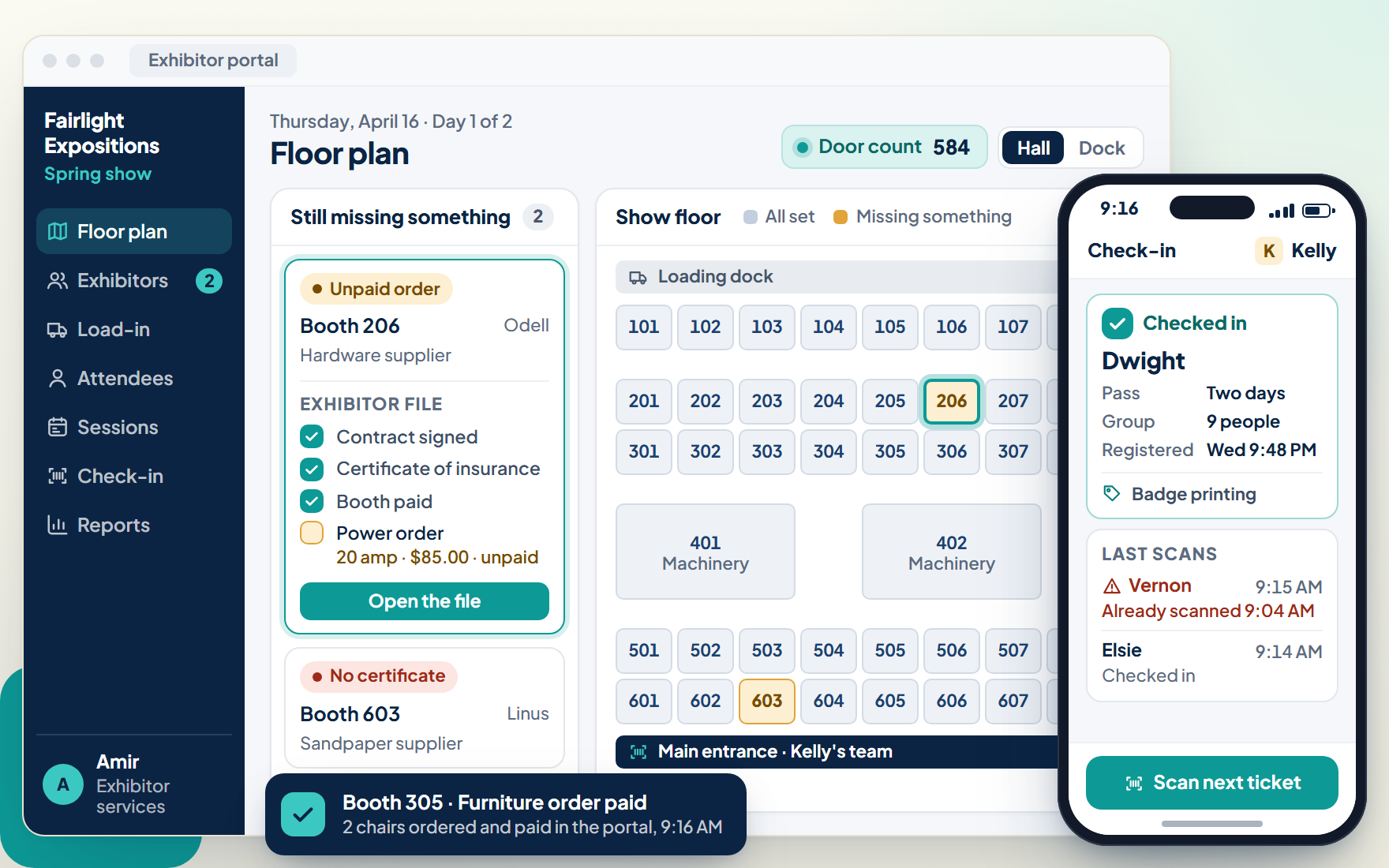
An exhibitor applies online with the company's details and product category, and Amir approves the application. The exhibitor signs the contract, uploads a certificate of insurance and opens the floor plan, which shows the open booths and what each costs. The booth they choose is held while they pay. Then they book a time at the dock, so trucks arrive in waves.
Each exhibitor has one file: the contract, the certificate, the payments and any order for power or furniture. Amir works from a list of the exhibitors still missing something.
Attendees register on the show's website, choose their sessions and get a ticket with a QR code by email. At the door, Kelly's staff and volunteers scan tickets with their own phones, and a badge prints as each person checks in. A ticket shown twice is flagged. The app keeps scanning where the hall's signal drops.
Stephanie watches the door count climb on her phone. After the show, reports give her attendance by session and any exhibitor balance still open.
The first weeks
Exhibitor applications opened in the fall, this time in the portal. Amir brought the returning exhibitors over from his spreadsheet and entered the floor plan booth by booth, each with its price.
Most exhibitors signed, uploaded and paid in one sitting. One longtime exhibitor called Amir in November, as he always had, for his usual corner booth, and learned that another company had picked it. Amir spent an afternoon helping him choose another.
Kelly's turn came in winter, when registration opened and tickets began going out by email. The week before the show she ran a practice check-in, and the badge printer jammed twice before anyone learned to load it.
A day now
The next spring the doors opened at nine again.
Kelly had eight people at the entrance, each holding a phone. A ticket was scanned, a badge printed, and the person walked in. A shop owner who had registered his crew the night before came through with all of them. The line stayed inside the lobby.
The trucks had come the day before at their booked times, and the dealer's panel saw was running before the doors opened. Amir's list of exhibitors still missing something had two names on it, and he knew where to find both.
Stephanie watched the door count rise on her phone. A little before ten she walked to the first session, where a volunteer stood at the door scanning tickets. She waited behind two cabinetmakers and went in to find a seat.
PlankByte
Case study
Custom software for small businesses.
plankbyte.com/case-studies/events-exhibitor-portal/
Contact: plankbyte.com/contact/