Case study
From a whiteboard to a dispatch board that follows every job from call to invoice
Stillwind Heating & Air is a heating and cooling shop with twelve technicians and one dispatcher. Its day lived on a whiteboard and in one person's head. This is the story of the week that stopped working, and of the dispatch board that took the whiteboard's place.
- Company
- Stillwind Heating & Air Residential and light-commercial heating and cooling
- Industry
- HVAC companies
- Location
- Central Oklahoma
- Size
- 34 employees, 12 service trucks
Before and after
What the software changes
-
Before The day's schedule lives in the dispatcher's head and on a whiteboard
After The board shows every technician, job and open call, and suggests who should take the next one
-
Before The technician arrives not knowing what unit is there
After The unit's make, model, install date and past repairs are on the job screen
-
Before Invoices are written in the truck and typed into accounting at the end of the week
After The invoice goes to the customer and to accounting when the job closes
-
Before Agreement tune-ups are tracked in a spreadsheet, and some are missed
After A job that covers an agreement visit checks that visit off
The story
The business
Stillwind Heating & Air is a heating and cooling shop in central Oklahoma. Dana started it with one van. Today she has twelve technicians on the road, a small office, and a few hundred homeowners on maintenance agreements, each of them owed a tune-up every spring and every fall.
For years the shop ran on a field-service app for its customer list and its estimates, and on whatever came to hand for everything the app didn't do. The day's schedule was on a whiteboard behind Marta, the dispatcher. The agreements were in a spreadsheet. Invoices were written in the trucks.
The problem
On the first hot Monday of June, the phones started before seven. By nine Marta had eleven calls waiting and a whiteboard that was already wrong: two technicians had traded jobs from the road, and nobody had told her. A woman whose air conditioning had quit over the weekend was promised a visit that morning, and promised it again that afternoon.
Across town Luis, the shop's senior technician, stood in a driveway looking at a unit he had never seen. The customer said someone from the shop had been out the summer before. Luis called the office to ask what had been done. Marta put him on hold.
On Friday the office stayed late, typing the week's handwritten invoices into the accounting software. One from Tuesday was missing. It turned up on Monday, under the seat of a truck.
That weekend Dana opened the agreements spreadsheet to see how the spring had gone. Some of the tune-ups her customers had already paid for had never been put on the schedule. Nobody had decided to skip them. They had simply never made it onto the whiteboard.
She didn't want to replace everything. The app the shop used was fine for estimates. What she wanted was the day in one place: every call, every technician, every agreement visit, and an invoice that nobody had to type twice.
What was built
PlankByte built a dispatch board that follows each job from the call to the invoice.
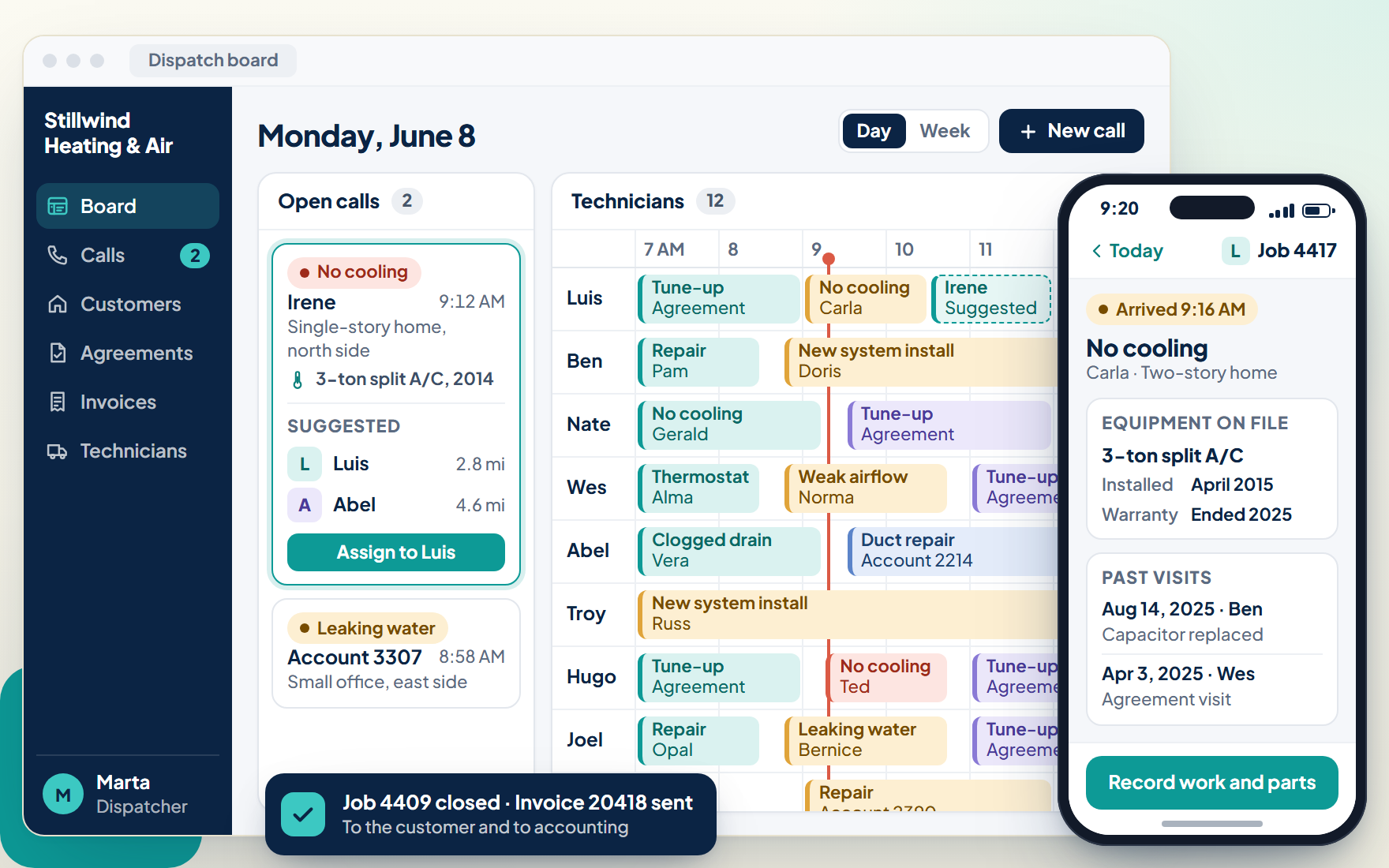
When a call comes in, Marta opens the customer's address and sees the equipment already on file. The board shows every technician, every job and every open call. For a new call it suggests the nearest technician with the right skills and an open slot. Marta still makes the decision.
On site, the job screen on Luis's phone shows the unit: its make and model, when it was installed, its warranty and every past visit. He records the work and the parts he used, and collects a signature. The app keeps working in an attic where the signal drops, and catches up when he is back in the truck.
When he closes the job, the invoice goes to the customer and into the accounting software the shop already used. Nobody types it again.
The maintenance agreements moved out of the spreadsheet. A tune-up that is due shows up on the board as a job to schedule. When a job covers an agreement visit, that visit is checked off on its own.
The first weeks
The shop switched in early spring, before the phones got busy. The customers' addresses and equipment came over from the old app, and the agreements from the spreadsheet. Plenty of units had no install date on file. Those were filled in one visit at a time, as a technician stood in front of each one.
For two weeks the whiteboard stayed up beside the screen, and Marta wrote on both. Then one morning she noticed she hadn't picked up the marker.
The technicians took longer. Recording parts on the phone before leaving the driveway was a new habit, and for a while the office still got parts written on paper. What won Luis over was the history. He told Dana he had stopped calling the office from driveways.
A day now
On the first hot Monday of the next June, the phones started before seven again.
Marta took the calls with the board open. Each one went to the technician the board suggested, or to the one she chose instead. When two technicians needed to trade jobs they asked her, and she moved the jobs on the board, so the board stayed right.
Luis read what had been done the August before, and then rang the doorbell.
Invoices went out as jobs closed. On Friday afternoon nobody in the office was typing them. The fall tune-ups were already waiting on the board as jobs to schedule.
It was still the busiest week of the year. This time the shop could see all of it.
PlankByte
Case study
Custom software for small businesses.
plankbyte.com/case-studies/hvac-dispatch-board/
Contact: plankbyte.com/contact/