Case study
From inboxes and a printed list to a client portal and a renewal queue for an insurance agency
Lakefog Insurance Group is an independent agency of twelve people with a mostly commercial book. A certificate of insurance meant dropping everything, policy changes waited in inboxes, and renewals were worked from a printed list. This is the story of one Thursday afternoon, and of the client portal and the work queues that came after it.
- Company
- Lakefog Insurance Group Independent insurance agency, mostly commercial lines
- Industry
- Insurance agencies
- Location
- Western New York
- Size
- 12 people, 1 office
Before and after
What the software changes
-
Before A certificate request means someone drops what they are doing
After The client asks in the portal, a customer service representative checks and approves it, and the certificate is sent and filed with the policy
-
Before Renewals are worked from a printed expiration list
After Every policy enters the renewal queue months before it expires, assigned to its account manager
-
Before A request to add a driver sits in one person's inbox
After The request lands in a service queue, with an owner and a due date
-
Before Showing that a coverage was offered means digging through years of email
After Notes on coverage offered or declined are on the client's record, with the requests and the certificates
The story
The business
Lakefog Insurance Group is an independent insurance agency in western New York. Twelve people work in its one office, and most of what they write is commercial: contractors, restaurants, landlords, a few small trucking companies. Greg is the principal.
The policies were in an agency management system. The work around them was not. Certificates were asked for by phone. Policy changes came by email, to whoever the client knew. Hector, an account manager, worked his renewals from an expiration list he printed each month. What had been offered to a client and turned down was somewhere in years of email.
The problem
On a Thursday in late April, at ten past four, a concrete contractor called for a certificate of insurance. His crew started a new job at seven the next morning, and the general contractor would let nobody through the gate without a certificate naming it as an additional insured.
Denise, a customer service representative, set aside the mortgagee change she was halfway through. The wording was the slow part: she had to read the policy to see that it was there. Hector knew the account, and he was on another line.
His caller ran a small trucking company and had emailed on Monday to add a driver. Now he wanted to know why it hadn't been done. The email had gone to a coworker who was out all week.
The certificate went out at twenty to six. The mortgagee change waited until Friday.
That afternoon the owner of a machine shop, a client for eleven years, told Greg he was moving to another agency. His renewal was three weeks off, the premium had gone up, and nobody had called him. The policy was on Hector's printed list, unmarked.
That call decided it. Greg did not want a new management system. He wanted clients to ask for routine things without a phone call, requests that didn't wait in one person's inbox, and renewals that came up on their own, each with a name on it.
What was built
PlankByte built a client portal and, behind it, two work queues for the office: one for service requests and one for renewals.
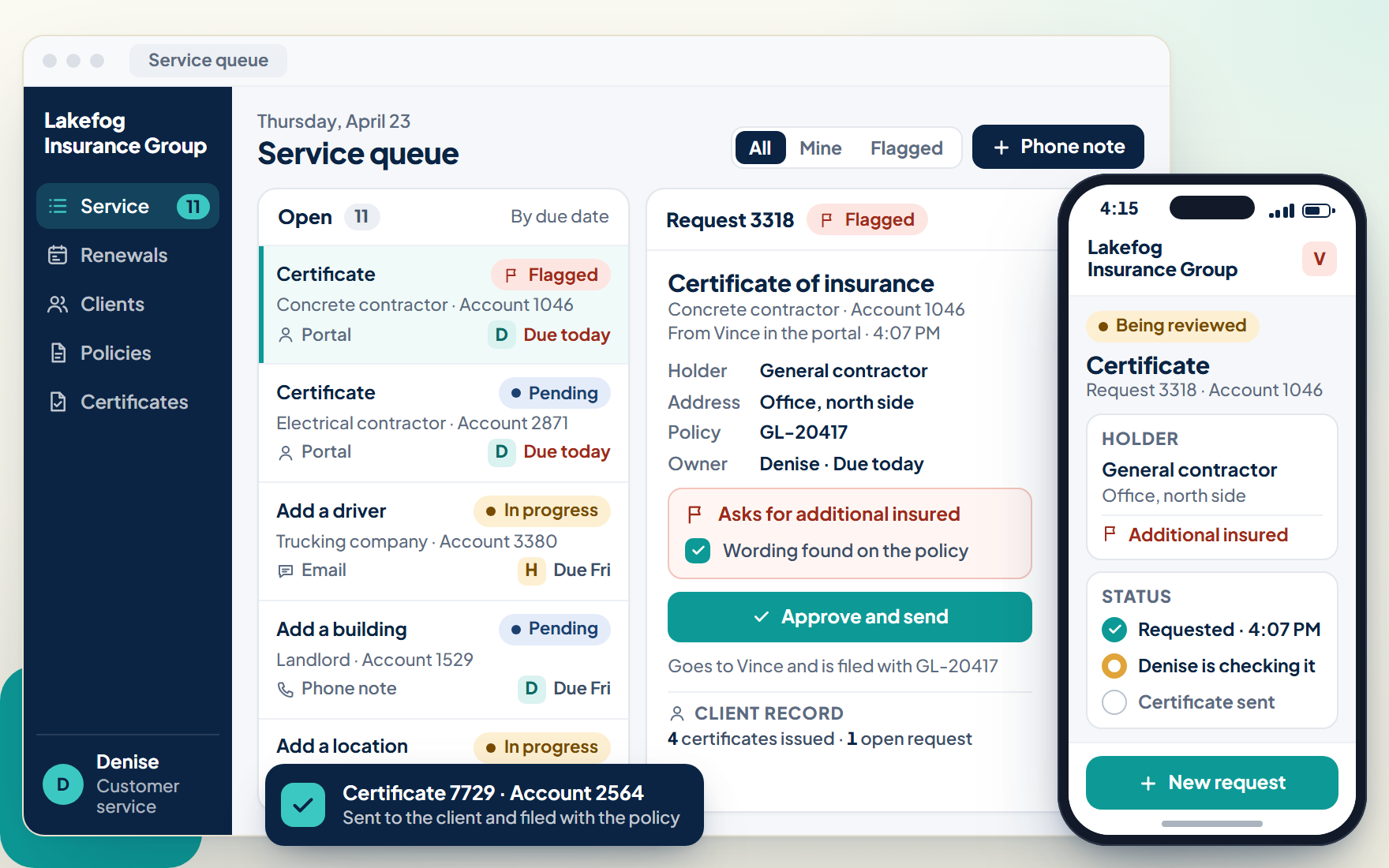
A client who needs a certificate signs in to the portal, enters the certificate holder's name and address, and submits the request. It lands in the service queue. Denise checks and approves it, and the certificate goes to the client and is filed with the policy. A request for special wording, such as additional insured status, is flagged for a closer look.
The same queue takes everything else. A request to add a driver gets an owner and a due date, whether it comes through the portal, by email or as a note from a phone call.
Every policy enters the renewal queue months before it expires, assigned to its account manager. Hector sees each renewal at ninety, sixty and thirty days out, with the current premium and the tasks due at that step.
Service requests, certificates issued and notes on coverage offered or declined stay on the client's record.
The first weeks
PlankByte looked first at what the agency management system would allow. Policies, expiration dates and contacts could be read from it, so nobody typed them again. The years of email stayed where they were. Notes on coverage offered began the day the agency switched.
The contacts were the trouble. Many were old: a bookkeeper who had left, an owner's personal email. Denise found the right person at each client one phone call at a time.
Plenty of clients kept calling, and Denise entered each call in the queue as a phone note. Hector had to get used to renewals arriving a few each morning instead of all at once.
A day now
On a Thursday the next April, a little after four, the same concrete contractor sent a request through the portal from his truck. It asked for additional insured status, so it was flagged.
Denise read the policy and approved the request. The certificate went to the contractor and into the policy's file, and she went back to what she had been doing.
A restaurant owner asked Hector whether he had ever been offered an umbrella policy. Hector opened the client's record and read him the note from the last renewal: offered, and declined.
Before he went home, Greg looked at the renewal queue. Every policy expiring in the next ninety days was on it, each with a name beside it.
The contractor's crew went through the gate at seven the next morning.
PlankByte
Case study
Custom software for small businesses.
plankbyte.com/case-studies/insurance-client-portal/
Contact: plankbyte.com/contact/