Case study
A landscaping company's rain day, from routes rebuilt by hand to a board that moves the whole week
Tierra Mansa Landscapes runs six mowing crews and one install crew. Every rain day cost Jenny, its scheduler, an evening of rebuilding routes by hand, and what each property needed was in the crew leaders' heads. This story follows one wet week in August, and a rain day the next summer, when a route board did the rebuilding.
- Company
- Tierra Mansa Landscapes Weekly grounds maintenance and landscape installation
- Industry
- Landscaping companies
- Location
- Central Florida
- Size
- 30 employees, 6 mowing crews and 1 install crew
Before and after
What the software changes
-
Before A rain day costs the scheduler an evening of rebuilding every route by hand
After The scheduler pushes the day's stops to the next day in one step, and the rest of the week moves with them
-
Before A new hire doesn't know the gate code, the dog or which bed to leave alone
After Each stop shows its gate code, notes and photos on the crew leader's phone
-
Before Time sheets show when a crew left the shop and came back, not how long it spent on each property
After Crew leaders clock in and out at each property, and the hours sit next to what the contract pays
-
Before Mowing routes are in a spreadsheet and installs on a wall calendar, so the same men get booked twice
After Mowing routes and install jobs are on one board, where people are assigned to trucks for the day
The story
The business
Tierra Mansa Landscapes looks after lawns and grounds in central Florida, where the grass is cut every week for most of the year. Mateo, the owner, has thirty people: six mowing crews on weekly contracts and one install crew that lays sod and plants beds.
Jenny, the scheduler, kept the mowing routes in a spreadsheet and printed a route sheet for each truck. The install jobs were on a wall calendar in Mateo's office. Gate codes, dogs and the beds a client wanted left alone were in the crew leaders' heads. Rafa, the longest-serving crew leader, carried the most.
The problem
On a Tuesday in August it was raining when the crews got to the shop. By eight the radar was solid green, and Mateo sent everyone home with eighty-some lawns uncut.
Jenny took the route sheets home and rebuilt the week by hand at her kitchen table: Tuesday's lawns onto Wednesday, Wednesday's onto Thursday, a Saturday added, stops traded between crews. After ten she sent the crew leaders a group text.
The wall calendar was not on the kitchen table. On Wednesday Rafa had the longest route of the summer, and the calendar had two of his men promised to the install crew for six pallets of sod. Sod doesn't keep in August. The install crew got the men.
Rafa left short-handed, with a new hire in his second week. Four of his stops were another crew's, behind a gate he had no code for, and he sat at the keypad waiting on a text. Later, while Rafa mowed out front, the new hire ran a trimmer through the milkweed a homeowner grew for butterflies. Rafa knew to leave it. Nobody had written it down.
On Saturday, with every crew out for a sixth day, Mateo tried to work out which properties were worth it. The time sheets showed when each crew left the shop and when it came back, and nothing in between.
He didn't want new accounting software, or anything that made a crew leader's day longer. He wanted a rain day to stop costing Jenny an evening, the notes written where the next person could read them, and the hours for each property.
What was built
PlankByte built a route board for the office and a screen for the crew leaders' phones.
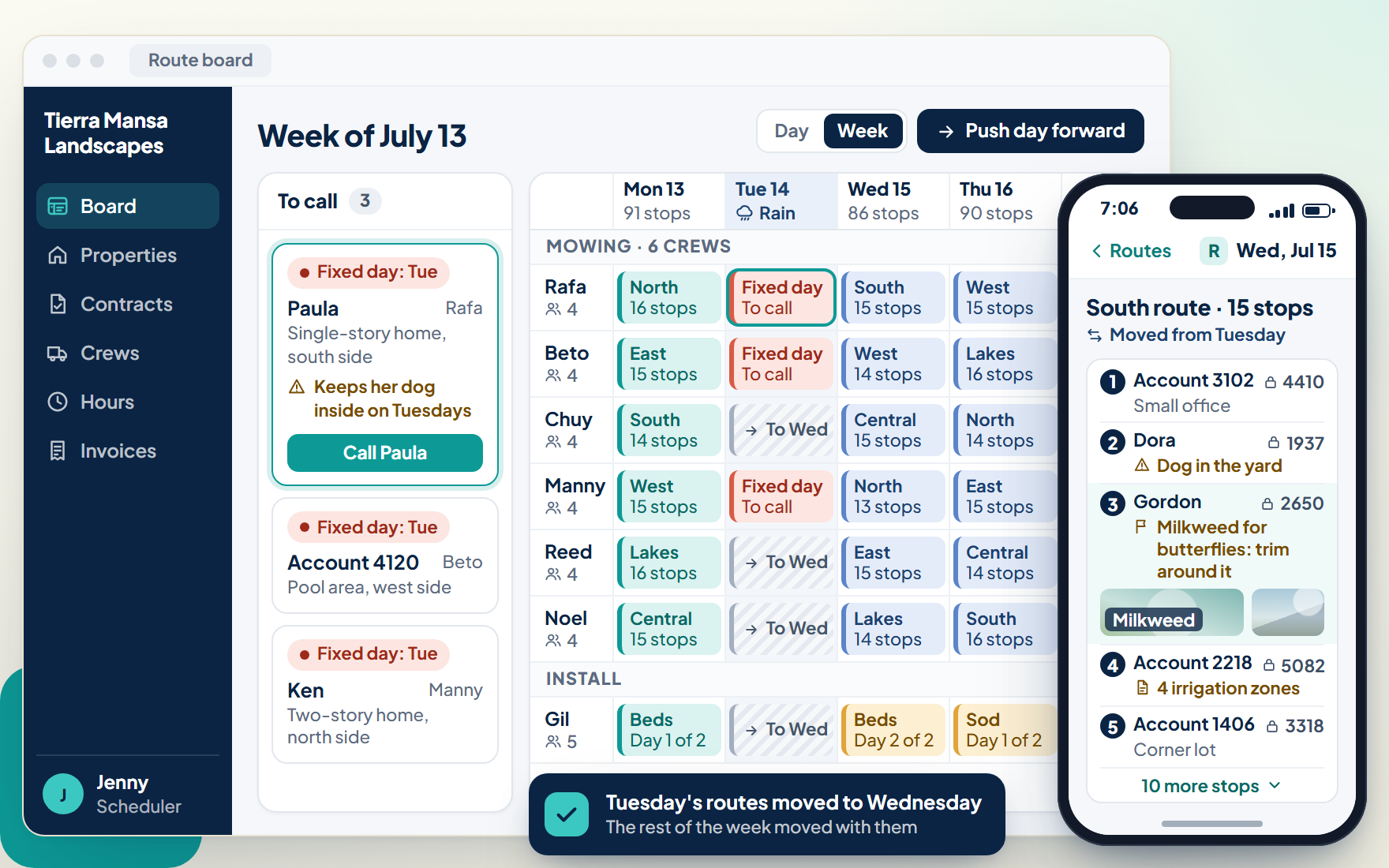
On Monday Jenny sees every crew's route for the week, built from the recurring contracts, with each day's stops ordered by area. The install jobs are on the same board, where she assigns people to trucks and routes for the day and sees who is already on an install.
When rain takes a day, she pushes that day's routes forward in one step, and the rest of the week moves with them. Customers who need a fixed day are not moved. The board flags them, and Jenny calls.
Rafa's phone shows the day's stops in their new order, each with its gate code, notes and photos: the dog, the irrigation zones, the milkweed. He taps in when the crew arrives and out when it leaves.
At the end of the week the finished visits become invoice lines on each customer's monthly bill, ready for the accounting software the company already used. Mateo sees each property's hours next to what its contract pays.
The first weeks
Mateo picked January for the change, when the grass slows down and most lawns are cut every other week. Jenny's spreadsheet gave the board its properties and contracts, and the wall calendar gave it the install jobs. The notes had never been written anywhere. Jenny sat with each crew leader and typed while they talked: codes, dogs, the pool screens a trimmer line will tear.
The crew leaders took to the list of stops quickly and to the clock slowly. For weeks somebody forgot to tap out most days, and a small yard would show a crew on it until lunch. Rafa made it part of loading up: mowers strapped down, then tap out.
A day now
On a Tuesday the following July it rained from before daylight, and Mateo sent the crews home again.
Jenny pushed Tuesday's routes to Wednesday before the last crew had left the lot. The board flagged three customers who needed their fixed day, among them a homeowner who keeps her dog inside on Tuesdays. Jenny called all three and went home at five.
On Wednesday Rafa left the shop with his whole crew and Tuesday's stops in order on his phone, each with its code. At the house with the butterflies he held the screen out to a new hire, who trimmed around the milkweed.
At the end of the week the visits were billed. Mateo went through each property's hours beside what its contract paid, and wrote down a few to look at again before renewal season.
PlankByte
Case study
Custom software for small businesses.
plankbyte.com/case-studies/landscaping-route-board/
Contact: plankbyte.com/contact/