Case study
A new client tells a law firm their story once, and the engagement letter follows from it
Cairnwell Legal is a firm of six lawyers with two practice areas. A new client told their story on the phone, wrote it on a paper form and told it again to a lawyer, while the conflict check went around by email. This is the story of one family's first week with the firm, and of another family's a year later.
- Company
- Cairnwell Legal Small law firm with two practice areas
- Industry
- Law firms
- Location
- Western Oregon
- Size
- 11 people, 6 of them lawyers
Before and after
What the software changes
-
Before A new client tells their story on the phone, writes it on a paper form, and someone types it in
After The client fills in one intake form online, and the answers open a pending matter
-
Before The conflict check is a search of an old matter list and an email to every lawyer
After The intake runs a conflict search across current and closed matters, and the person in charge reviews the hits and signs off
-
Before The engagement letter is typed over the last one somebody wrote
After The letter is drafted from the intake answers with the firm's template, approved by an attorney and sent for e-signature
-
Before Each lawyer keeps deadlines in their own calendar
After Once the letter is signed, the matter opens with its practice area's tasks and first deadlines on the firm's calendar
The story
The business
Cairnwell Legal is a firm of six lawyers in western Oregon with two practice areas: estates and probate, and family law. Eleven people work there. Margaret, the managing partner, built the estates side, and she is also the one who clears conflicts for the whole firm. Faye, the intake coordinator, is the first person a new client talks to.
For years a new client reached the firm three times over. They told Faye their story on the phone. They wrote it again on a paper form in the waiting room. Then Faye typed the form into the firm's records, and the lawyer who took the matter asked the same questions once more.
The problem
On a Monday in March a woman called about her mother's estate. Her mother had died in February, her brother had moved into the house, and she didn't know what she was supposed to do first. She told Faye all of it, and Faye wrote it on a notepad.
On Wednesday she came in and filled out the paper form on a clipboard: her name, her brother's, her mother's, the dates. On Thursday she sat down with Diego, the attorney who had taken the consultation, and he began by asking who had died and when. She said she had already told two people.
The conflict check, meanwhile, was an email. Faye had searched the old matter list for the family's name, found nothing and written to all six lawyers to ask whether anyone knew it. Four answered. Margaret was in hearings most of that week, and the yes had to be hers.
The engagement letter waited on that yes. When it came, the following Tuesday, Diego opened the last letter he had written, changed the names and the scope, and nearly sent it with another client's fee terms in the second paragraph. Faye caught it. The matter's first deadline went into Diego's own calendar, where nobody else could see it.
Margaret did not want software that decided anything. A conflict was her call, and a letter was a lawyer's. She wanted a client to tell the story once, and she wanted to stop being the reason a letter sat for a week.
What was built
PlankByte built an intake that starts on the firm's website and ends in a signed engagement letter.
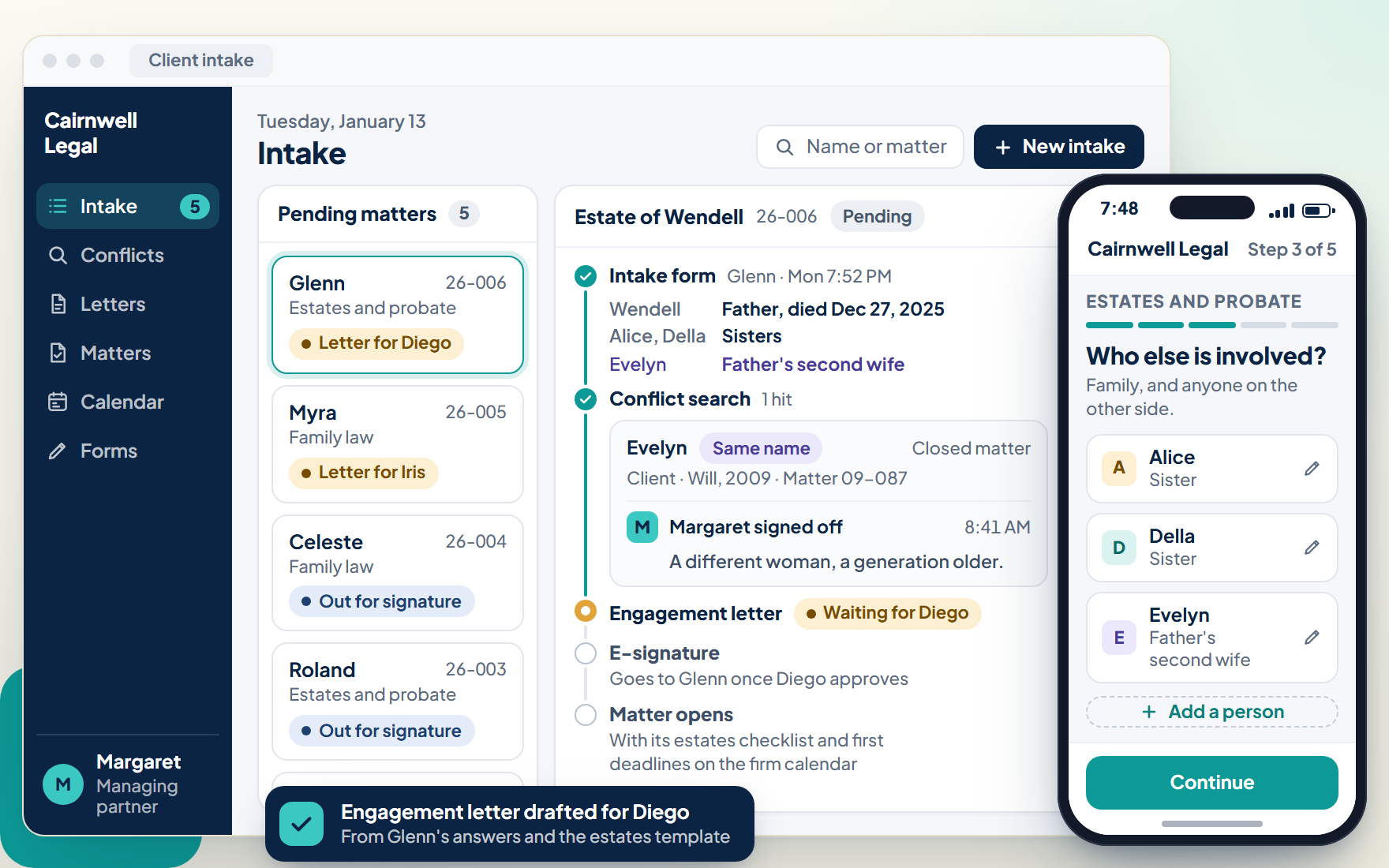
A prospective client fills in one form, written for the practice area they choose: who they are, who else is involved or on the other side, and what happened, with the dates. Nobody types the answers again. They open a pending matter.
The same answers run a conflict search across every current and closed matter: the client, the other parties and related names, including names spelled nearly the same way. The hits go to Margaret. She reviews them and signs off, and her decision is saved with the matter.
Then the engagement letter is drafted from the intake answers with the firm's own template: the scope, the fee terms, the client's details. Nothing goes out until an attorney approves it. Diego reads the letter and approves it, and it is sent for e-signature.
When the signed letter comes back, the matter opens. It has its responsible attorney, the checklist for its practice area and its first deadlines, which go on the firm's calendar, where everyone can see them.
The first weeks
The firm turned on the estates form first and the family law form a month later. Writing the questions was the slow part. Margaret and Diego went through three drafts of the estates form before it asked what they really asked in a first meeting, and no more than that.
The old matter list had to come over before the conflict search meant anything. It held twenty years of names in every format, some of them a surname and nothing else. Faye cleaned it up over several weeks, a few hundred names at a time.
Not every client wanted a form. Some still called, and Faye filled in the form with them on the phone, reading each answer back. Those answers went to the same place as the rest.
A day now
On a Monday evening the next January a man filled in the estates form at his kitchen table. His father had died over the holidays. He listed his two sisters and his father's second wife.
The conflict search found one hit: years earlier the firm had drafted a will for a woman with the second wife's name. It was in front of Margaret on Tuesday morning. She opened the old matter, saw that it was a different woman, a generation older, and signed off before her first appointment.
Diego approved the letter that afternoon, and the man signed it on his phone that night.
On Wednesday the matter was open, with its checklist, and its first deadline was on the firm's calendar. When the man came in on Thursday, Diego did not ask him who had died. He asked about the house.
PlankByte
Case study
Custom software for small businesses.
plankbyte.com/case-studies/legal-online-intake/
Contact: plankbyte.com/contact/