Case study
A signed bill of lading photographed at the dock, and the invoice out before the truck leaves
Fencepost Freight is a regional carrier with twenty-five trucks and two dispatchers. A load couldn't be billed until its signed paperwork reached the office, and some of it took a week. This is the story of one load of feed, and of what the same delivery looked like a year later.
- Company
- Fencepost Freight Regional truckload freight
- Industry
- Trucking and logistics companies
- Location
- Central Nebraska
- Size
- 42 employees, 25 trucks
Before and after
What the software changes
-
Before A load can't be invoiced until the signed BOL reaches the office
After The driver photographs the signed BOL at the receiver, and the invoice goes out with it attached
-
Before Shippers call all afternoon to ask where their freight is
After The shipper follows the load on a tracking page
-
Before Loads are typed into a spreadsheet and texted to drivers
After Dispatch enters the rate confirmation once, and the driver sees the load on their phone
-
Before Settlement day is worked out by hand for every driver
After Each load's pay lands on the driver's settlement, with detention added when a stop runs long
The story
The business
Fencepost Freight hauls regional truckload freight out of central Nebraska: feed, packaged food and farm supplies, mostly on runs that are out and back in a day or two. Joyce owns it. She has twenty-five trucks, two dispatchers and a small office that does the billing and the drivers' pay.
Loads were booked on the phone, typed into a spreadsheet and texted to the driver. The paperwork rode in the cab. A load was billed when its signed bill of lading, the BOL, reached the office, and the drivers' settlements were worked out by hand every Friday.
The problem
One Tuesday in October, Curtis delivered a load of bagged feed to a receiver three hours from the yard. The dock was backed up, and he sat for most of the afternoon before he was unloaded. The receiver signed the BOL, Curtis put it in the door pocket of his truck, and he picked up his next load in the morning without coming back through the yard.
The following Monday, the office went to invoice the feed load and couldn't. The signed BOL was the proof the shipper asked for, and it was still in the door pocket, three hundred miles away. Nobody had written down how long Curtis had waited at the dock, so the detention the rate confirmation allowed for was a guess, and the office left it off.
That same afternoon a shipper called Eddie, the dispatcher, three times to ask where a different load was. Each time Eddie called the driver, wrote down the name of a town and called the shipper back.
On Friday Joyce stayed late with the spreadsheet, the texts and a calculator, working out each driver's settlement: miles, stops, advances. Curtis asked about his afternoon at the dock. She had no time written down to pay him from.
What she wanted was not much. To enter a load once. To have the signed paper the day it was signed. To stop being the last to know where her own trucks were.
What was built
PlankByte built Fencepost a system that carries each load from the rate confirmation to the invoice.
Eddie enters the rate confirmation once: the stops, the appointment times, the reference numbers and the agreed rate. He assigns a driver and a truck. The load appears on the driver's phone, and nobody texts it.
The shipper has a tracking page that shows only its own loads: the status, the last known location and the expected delivery. It updates as the truck's locations come in from the electronic logging devices the trucks already carried.
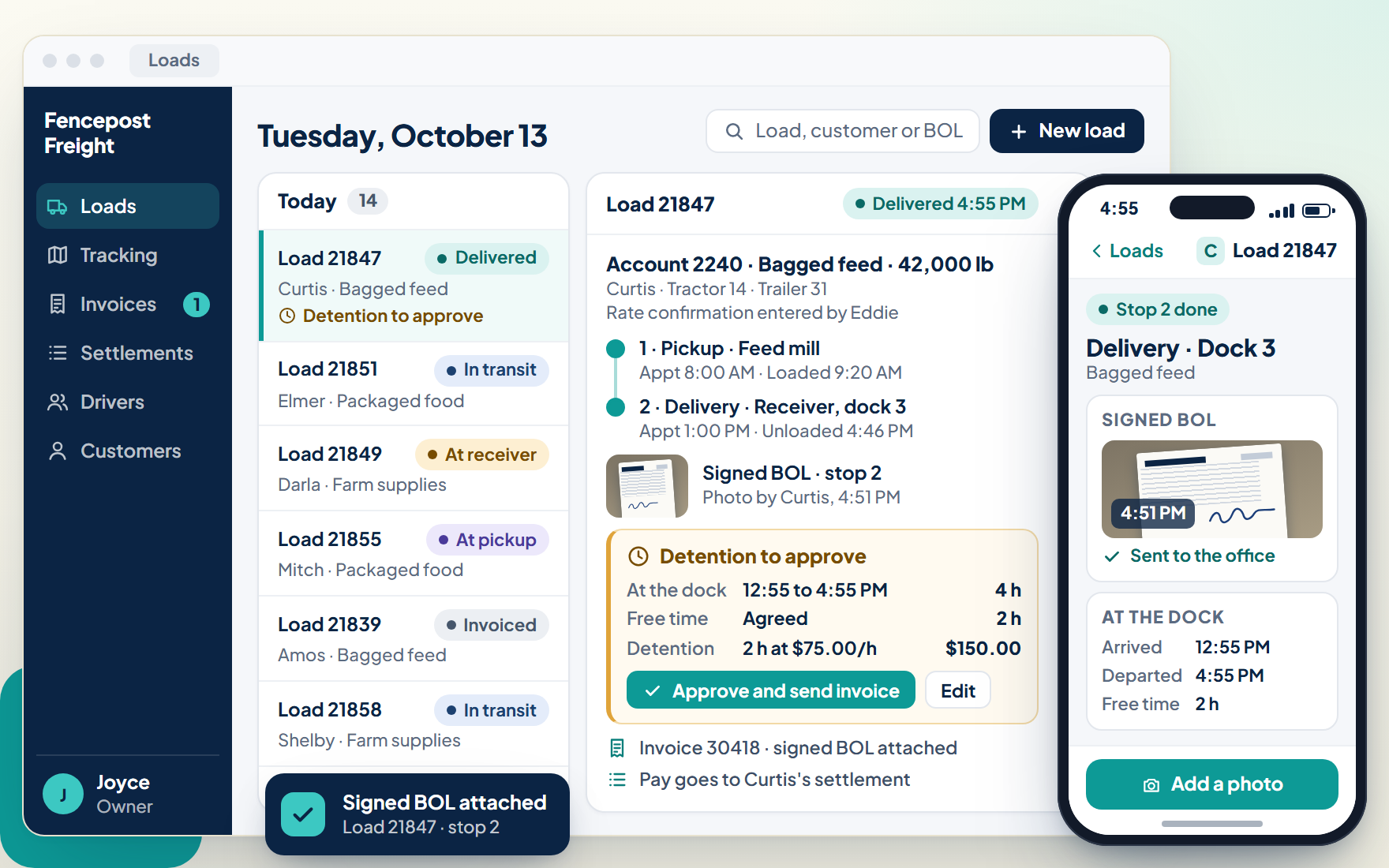
At the receiver, Curtis photographs the signed BOL before he pulls away from the dock. The photo attaches to the load and to that stop, with the time it was taken. His arrival and departure times are compared with the free time on the rate confirmation, and if the stop ran long, detention is added for the office to approve.
Then the invoice goes to the customer with the paperwork attached, and into the accounting software the office already used. When the load closes, its pay goes onto Curtis's weekly settlement, beside any advances Joyce has recorded.
The first weeks
Fencepost started with five trucks and the drivers who were handiest with a phone, Curtis among them. The open loads were entered from the spreadsheet a few at a time. For a month the office kept the spreadsheet going as well, until the day Eddie realized he had forgotten to update it and nothing had gone wrong.
The photographs took practice. The first week brought in pictures of the wrong page, one with a thumb over the signature and one taken in a dark cab. The office sent those back the same day, while the driver could still fix them, and that was already better than waiting a week.
Some shippers kept calling out of habit. Eddie sent them the link to their tracking page again, and in time most of them used it.
A day now
One Tuesday the next fall, Curtis delivered feed to the same receiver. The dock was backed up again.
He was unloaded late in the afternoon. He photographed the signed BOL at the dock and pulled out. In the office the load showed as delivered, with the paper attached and the afternoon's wait added as detention to approve. Joyce approved it, and the invoice left before Curtis reached the highway.
The shipper never called. Its page had shown the truck at the receiver all afternoon.
On Friday the settlements were already built from the week's loads. Joyce read them through, corrected one advance and went home. Curtis's had the time at the dock on it.
PlankByte
Case study
Custom software for small businesses.
plankbyte.com/case-studies/logistics-proof-of-delivery/
Contact: plankbyte.com/contact/