Case study
A job shop puts a tablet at every station, and knows where each job is and which lot it was cut from
Tramline Machine & Assembly is a job shop of thirty-one people that ran every job on a paper traveler. When a customer reported a cracked part, nobody could say which lot of bar it was cut from. What follows is that day, and a later one, after a tablet went in at every station.
- Company
- Tramline Machine & Assembly Contract machining and assembly
- Industry
- Small manufacturers
- Location
- Western Michigan
- Size
- 31 employees, 1 shop
Before and after
What the software changes
-
Before Finding out where a job is means walking the floor and reading travelers
After The office sees which station each work order is at
-
Before A material shortage is found the morning the job should start
After Material is reserved against the bill of materials when the work order is released
-
Before Nobody can say which lot of material a bad part came from
After The material lots stay on file with every shipment
-
Before Inspection sheets live in binders
After Inspection steps ask for measurements at the station, and a failed check opens a nonconformance record
The story
The business
Tramline Machine & Assembly is a job shop in western Michigan. Hal, the owner, has thirty-one people and one shop floor: saws, lathes, mills and an assembly bench at the back. It machines parts to its customers' drawings and assembles some into finished units.
For years every job crossed the floor with a paper traveler. Dee, the production scheduler, kept the schedule in a spreadsheet and walked the floor twice a day to correct it. Min, the quality lead, filed the inspection sheets in binders, a shelf of them.
The problem
On a Tuesday in March, a customer's buyer called Hal. A shaft from Tramline had cracked at the keyway when a gear was pressed onto it. The buyer asked which lot of bar it was cut from, and whether the other shafts on his shelf came from the same one.
The morning had been bad already. A job was due on the lathe at seven, and the rack held half the bar it needed. Dee had spent the first hour on the phone with the supplier.
Min went to the binders. By mid-afternoon she had the job's traveler and its inspection sheet. The first-piece measurements were there. The material lot was not. Two lots of that bar had come in over the winter, and nothing said which one went to the saw.
Hal asked Dee where that customer's open order stood. She walked the floor reading travelers until she found it on a cart by the mills.
Before five Hal called the buyer back and told him he couldn't say which lot. The customer pulled every Tramline shaft off its shelf, three shipments of them, and sent them all back. Hal did not intend to make that call twice.
He didn't want to change how the shop quoted or kept its books, and he didn't want machinists typing. He wanted the traveler to stop being the only thing that knew where a job stood, what it was cut from and what its parts had measured.
What was built
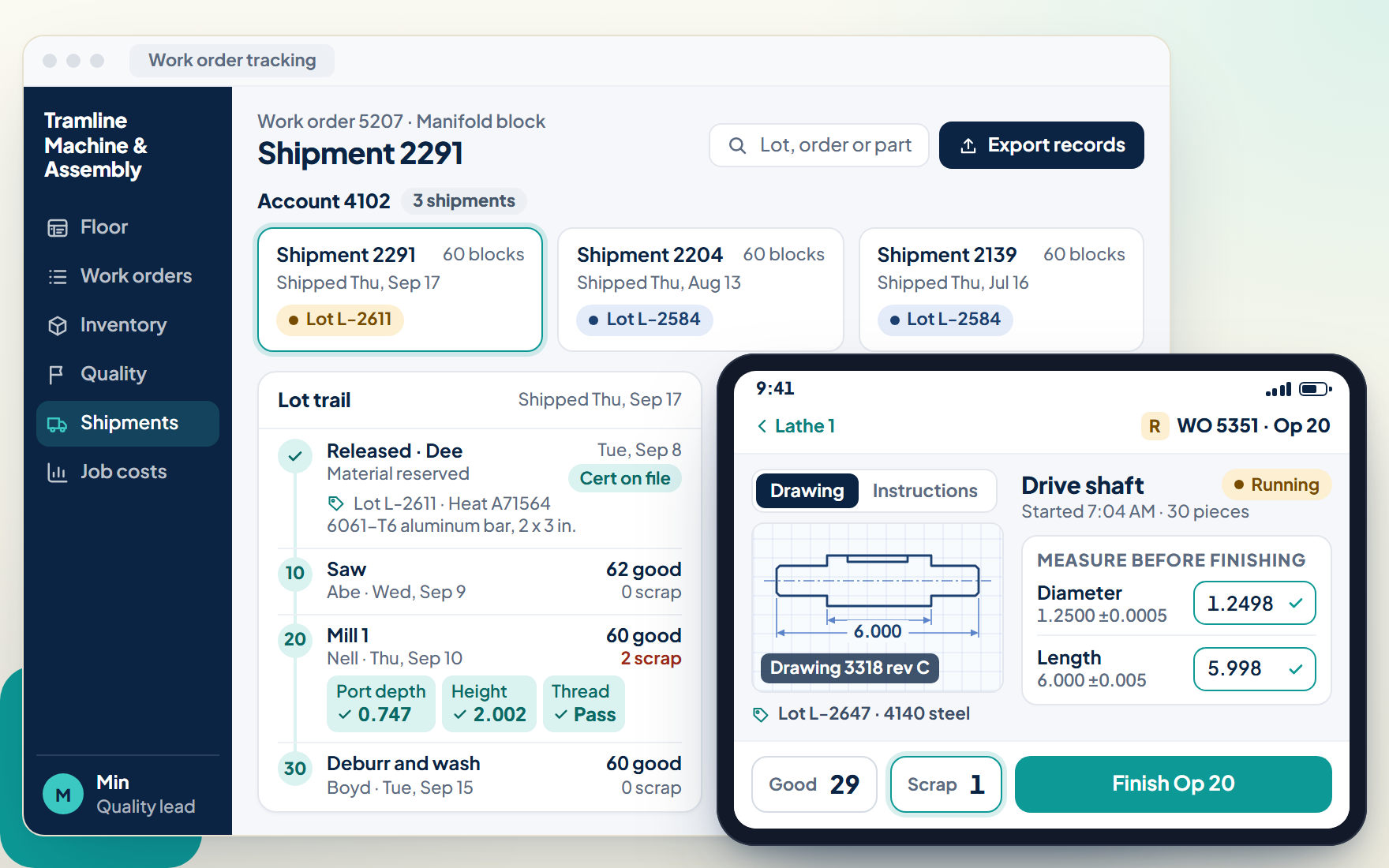
PlankByte built a tablet screen for each station and an office screen that follows every work order from release to shipment.
When Dee releases a work order, its material is reserved from stock against the bill of materials, and the order keeps the lot numbers of that bar. If the rack is short, she sees it then, while there is still time to buy.
At the lathe, the operator picks the job on the tablet and sees the drawing and the work instructions. One tap starts the operation. At the end, the tablet asks for two counts: good parts and scrap.
Where the routing calls for an inspection, the tablet asks for the measurements before the job can move on. A measurement out of tolerance opens a nonconformance record, and the parts wait until Min decides to rework, scrap or accept them.
From her desk, Dee sees which station each order is at and which are running, waiting or late. Hal sees each job's hours against the quote, by operation, while it is still on the floor.
When an order ships, the material lots, the operators and the inspection results stay on file with it.
The first weeks
The tablets went in at the two lathes first, where jobs had always backed up, and at the other stations after that. Routings for repeat jobs were entered once and copied from then on. The rack was counted on a Saturday. A good many remnants had no tag, and Hal sold them for scrap rather than give them a lot number somebody had guessed.
Scrap was the hard part. On paper, a scrapped part had been easy to leave off the traveler. The tablet asked for a count every time, and for a while the numbers were hard to look at.
The old binders stayed on Min's shelf. Nobody typed them in.
A day now
On a Thursday in October, a job was due on the lathe at seven. Its bar had been reserved since Dee released the order.
At nine a different customer wrote to Min. An aluminum block from a shipment the month before had cracked at a threaded port. She opened the shipment on her screen: the lot the blocks were cut from, who had run each operation, the measurements entered at the mill. That customer's two earlier shipments had come from another lot.
She sent all of it before lunch, and Hal phoned that customer's buyer with the lot number in front of him. The customer set one shipment aside and kept using the other two.
The buyer asked where his open order stood. Dee read it off her screen: at the assembly bench, started that morning.
Before she went home she released the replacement order. Its bar was on the rack, and the order kept the lot number.
PlankByte
Case study
Custom software for small businesses.
plankbyte.com/case-studies/manufacturing-station-tablets/
Contact: plankbyte.com/contact/