Case study
A food pantry moves from group email to a volunteer schedule that fills in the grant report
The Long Ladle Pantry is a food pantry with six staff and about two hundred volunteers. It filled its shifts by group email and counted volunteer hours from sign-in sheets, until a Saturday morning when nobody came to sort. In this story a volunteer schedule replaces both, and the hours for the grant report are counted as they are worked.
- Company
- The Long Ladle Pantry Food pantry
- Industry
- Nonprofit organizations
- Location
- Eastern Iowa
- Size
- 6 staff, about 200 volunteers
Before and after
What the software changes
-
Before Shifts are filled by group email, and on Saturday nobody comes
After Volunteers pick a shift from a link and get a reminder the day before
-
Before Volunteer hours are pieced together from sign-in sheets
After Volunteers check in on a tablet, and their hours are recorded against the program and the grant that pays for it
-
Before A quarterly report to a foundation means a week of counting by hand
After Hours, shifts filled and families served are already counted for that program and that period
The story
The business
The Long Ladle Pantry is a food pantry in eastern Iowa. It has six staff and about two hundred volunteers, and the volunteers do most of the lifting. On weekdays they keep the shelves stocked. On Saturday mornings they sort what the food bank's truck left on Friday and hand it out at the Saturday distribution.
Carol, the director, kept gifts in a ready-made donor system, and it did that job well. Javier, the volunteer coordinator, filled shifts by group email. Volunteers wrote their names on a sign-in sheet by the door, and four times a year Nadia, the grants manager, turned those sheets into a report for a foundation.
The problem
On the second Saturday of March, Javier had the side door open by seven, and nobody came to sort. Friday's truck had left six pallets. The doors were due to open at nine.
His group email had gone out on Tuesday. A few people had replied to everyone that they would try, and each had assumed the others would be there. Javier worked down his phone list and reached two volunteers. Carol drove in from home, and Nadia left the quarterly report she had come in to finish. Together they sorted cans and bagged produce. The doors opened most of an hour late, and families who had come on time waited outside in the cold.
The report was still due. Nadia spent the next week with a stack of sign-in sheets: first names in pencil, a time in and rarely a time out, and nothing to show which hours belonged to the Saturday distribution, the program the foundation's grant paid for.
After that week Carol went looking for help. She did not want a new donor system, and she was not going to ask a volunteer of twenty years to download an app. She wanted to know by Thursday who was coming on Saturday, and she wanted hours that nobody had to count afterwards.
What was built
PlankByte built a volunteer schedule that fills in the grant report as the shifts are worked.
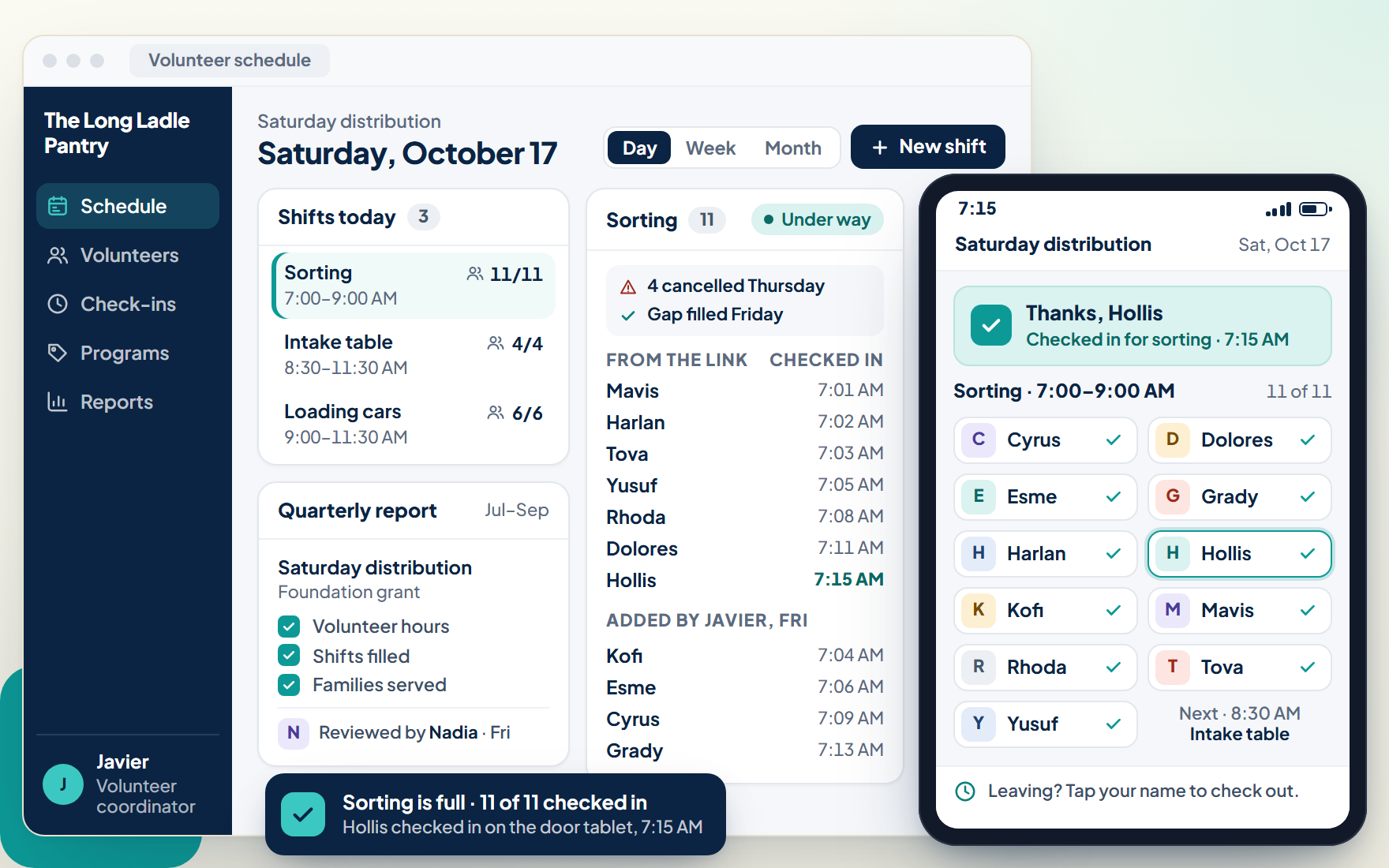
Javier posts next month's shifts for the weekday pantry and the Saturday distribution: sorting, the intake table, loading cars. Each shift belongs to a program and to the grant that pays for it. A volunteer opens the link on a phone, picks a shift and gets a reminder the day before. There is nothing to install and no password. When someone would rather call the office, Javier signs them up himself.
When a volunteer cancels, Javier sees the gap, and next to it the volunteers who usually take that shift.
At the door, volunteers check in on a tablet, and check out when they leave. Their hours are recorded that day, against the program and the grant. The families served at each distribution are recorded against the same program.
When a quarterly report comes due, Nadia chooses the program and the period. Volunteer hours, shifts filled and families served are already counted, ready for her to review. Carol takes the same numbers to the board.
The first weeks
The first shifts went up in May, for June. Javier's list of volunteers came over from a spreadsheet and from years of email threads. The old sign-in sheets stayed on paper, and Nadia counted one more quarter by hand.
Javier sent one last group email, with the link in it. Several longtime volunteers had come every Saturday for years without being asked, and for the first month Javier signed them up himself as they walked in. A retired teacher never used the link. She called the office each month, and Javier put her down for her Saturdays.
Checking out took the longest. People finished, hung up their aprons and went home, and the tablet had them arriving and never leaving. Javier moved it to a stand beside the coat hooks, where nobody could leave without walking past it.
A day now
On a Thursday night in October, four students cancelled their Saturday sorting shift. On Friday morning Javier saw the gap, and beside it the volunteers who usually took that shift. He made five calls before lunch.
On Saturday he had the side door open by seven. By a quarter past, eleven volunteers had checked in on the tablet, and the sorting tables were full.
Nadia was at home. Her quarterly report was due the next week, with the hours, the shifts filled and the families served for the Saturday distribution already counted. She had read them through on Friday.
At nine, Carol propped the doors open.
PlankByte
Case study
Custom software for small businesses.
plankbyte.com/case-studies/nonprofits-volunteer-schedule/
Contact: plankbyte.com/contact/