Case study
Quarterly visits that schedule the next one, for a pest control company that ran on a wall calendar
Marshwren Pest Control has eight technicians and about two thousand recurring accounts. Every quarterly visit used to be written on a wall calendar by hand, and now and then one never was. One July morning a customer called to ask why nobody had been out. After that, the calendar gave way to service plans that put each next visit on the schedule themselves.
- Company
- Marshwren Pest Control Recurring pest control for homes and businesses
- Industry
- Pest control companies
- Location
- Coastal South Carolina
- Size
- 13 employees, 8 technicians
Before and after
What the software changes
-
Before Quarterly visits are written on a wall calendar by hand, and some are never written
After Marking a visit done puts the next one on the schedule, on the route that covers that street
-
Before Routes follow the order the visits were booked, and send a technician back and forth across the same bridge
After Each day's stops are grouped by area and put in driving order
-
Before Finding out what was applied at a house means digging through a box of paper tickets
After Each visit's products, amounts, areas and target pests are in the property's record
-
Before The only sign of a visit is a paper ticket left in the door
After The service report goes to the customer by email when the visit is marked done
The story
The business
Marshwren Pest Control is a pest control company in coastal South Carolina. It has thirteen employees, eight of them technicians, and about two thousand accounts on a recurring plan: houses treated every quarter, restaurants seen every month, and yards sprayed for mosquitoes through the summer.
All of it used to run through Tamika, the office manager. Each afternoon the technicians turned in their paper service tickets, and she wrote every quarterly customer's next visit on a wall calendar, three months out. Then the tickets went into a box, one for each month. Routes were typed up in the order the visits had been booked.
The problem
On a Tuesday in late July, the first call of the morning came from a quarterly customer of six years. She had found a palmetto bug in her bathtub, and she couldn't remember a visit since February. She asked Tamika why nobody had been out.
Tamika turned the calendar back to May. The visit had never been written there, and nothing said why.
The customer also had a new puppy, and wanted to know what had been put down around her back porch in February. Tamika found the ticket near the bottom of the February box. The product was in a technician's shorthand. The amount was blank.
Tamika added the house to the end of Jorge's day. Jorge, a technician, already had eleven stops, and had crossed the same bridge going out, coming back and going out again. He reached the house after six. The customer told him the only sign anyone ever came was a yellow ticket tucked in her door.
Frank, the owner, asked Tamika how many other visits were missing from the calendar. She told him the only way to know was to check all two thousand accounts against it.
He didn't want software that told his technicians how to treat a house. He wanted visits that couldn't fall off the schedule, routes that made sense, and a record of what had been put down that didn't live in a box.
What was built
PlankByte built service plans that schedule their own visits, with each day's route and the treatment record on the technician's phone.
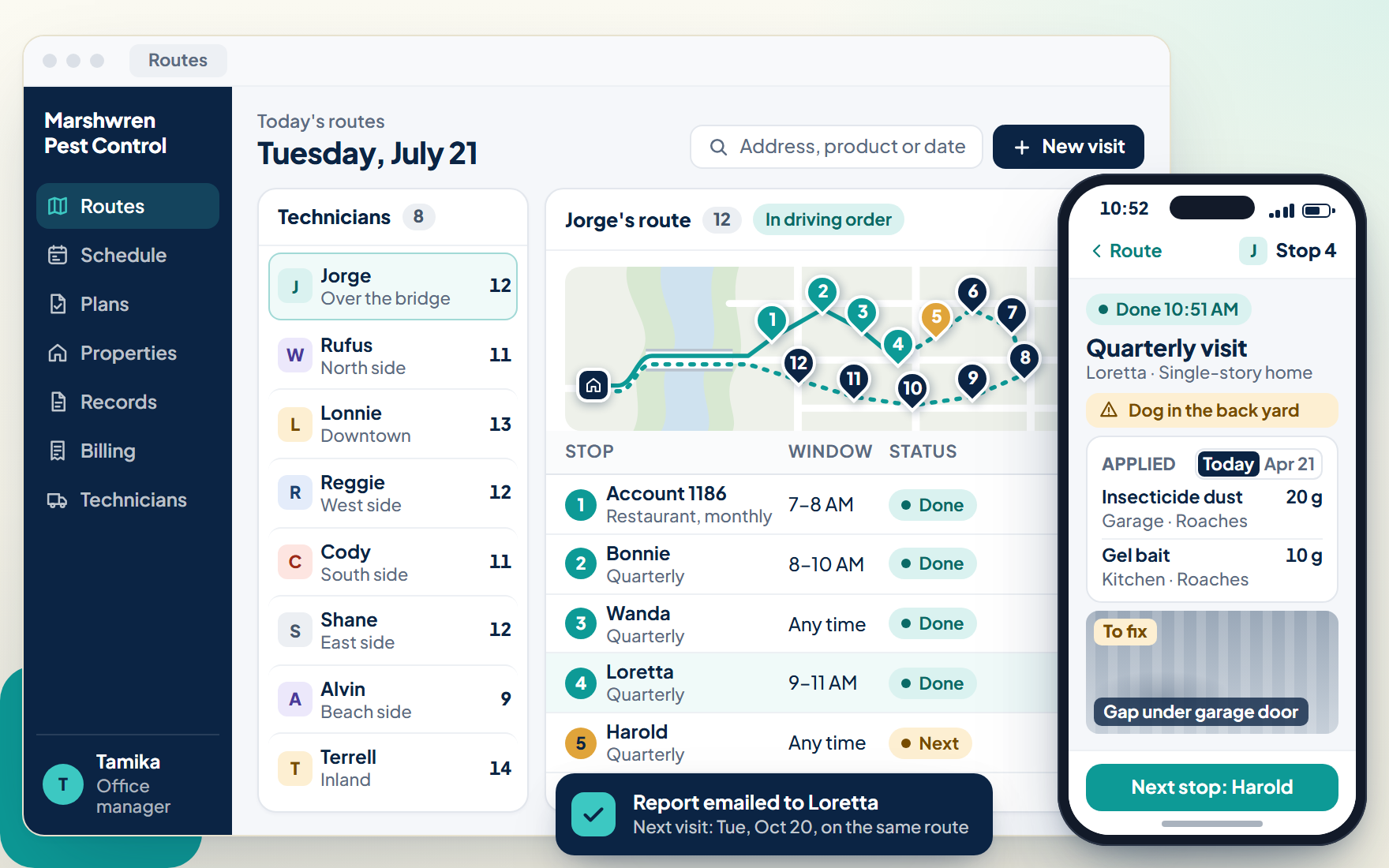
Every recurring customer has a plan: monthly, quarterly or seasonal. The plan creates the visits, so nobody writes them on a calendar. Each day's stops are grouped by area and put in driving order, around the appointment windows customers were given.
Jorge opens his route on his phone. At each house he sees the pest history, the last treatment and notes such as a gate code or a dog in the back yard. He logs each product from the company's list with the amount, the area and the target pest. He notes anything the homeowner should fix and adds photos.
When he marks the visit done, the customer gets the service report by email: what was inspected and treated, the photos, what to fix and the date of the next visit. The charge goes to billing under the plan. The next quarterly visit goes on the schedule, on the route that covers that street.
Every visit stays in the property's record, and Tamika can search the records by address, product or date.
The first weeks
The changeover came in January, when the routes were lightest. Every account needed a plan and a next visit to start from, so Tamika and Frank went through the calendar a month at a time. A few dozen accounts had no visit written anywhere. Those customers were called first. The boxes of old tickets stayed on the shelf.
The first routes were in driving order and still wrong in places. A restaurant kitchen had to be treated before the cooks came in, and nobody had entered that window until a technician spoke up.
Jorge had always written his tickets in the truck at the end of the day, from memory. Now he logged each product at the house, and because many accounts had no email address on file, he asked for one at every door that first quarter.
A day now
On a Tuesday the following July, the same customer was Jorge's fourth stop, between two other houses on her side of the bridge.
Before he knocked, his phone showed him the note about the dog in the back yard and what had been applied in April. He treated the house, logged two products and photographed a gap under the garage door. When he marked the visit done, the report went to her email, and her October visit was already on the schedule.
At the office, a man called to ask what had been used in his kitchen that spring, and Tamika read it to him while he was still on the line.
Jorge crossed the bridge once on the way out and once on the way home.
PlankByte
Case study
Custom software for small businesses.
plankbyte.com/case-studies/pest-control-recurring-visits/
Contact: plankbyte.com/contact/