Case study
A night emergency that no longer costs a plumbing shop its next morning
Coppervane Plumbing runs eight trucks and takes emergency calls day and night. For years, a water heater that let go at midnight cost its office the next morning too. Here is one of those nights, and the same kind of night after PlankByte built a way to carry the call from the first ring to the paid invoice.
- Company
- Coppervane Plumbing Residential plumbing service and repair, day and night
- Industry
- Plumbing companies
- Location
- Western Pennsylvania
- Size
- 14 employees, 8 trucks
Before and after
What the software changes
-
Before The morning after a night emergency, half the day's appointments are moved by text message
After The office starts the day with a schedule already adjusted for the plumber who was up late
-
Before Estimates are written on a carbon pad and typed up the next day
After The plumber builds the estimate from the price book on site, and the customer picks an option and signs
-
Before Nobody knows which truck has the right fittings
After Each truck's stock is counted down as parts go onto a job, and the office gets a restock list
-
Before Parts come off the truck and never reach the invoice
After The parts used are on the invoice, which is paid before the plumber leaves
The story
The business
Coppervane Plumbing does residential service and repair in western Pennsylvania, day and night. Owen has owned it since the years when he took every night call himself. Today it has eight trucks and fourteen people, and the plumbers take turns on call.
By day Priya, the office manager, ran the schedule from a scheduling app. At night an answering service rang whoever was on call. The prices were on a sheet in a binder in every truck, estimates went on a carbon pad, and each plumber kept his truck's stock in his head.
The problem
A water heater let go a little after midnight on a Tuesday in January. The answering service took a name, a street and the words water heater leaking, and rang Marcus, the plumber on call. That was all he had to go on.
The shutoff above the heater was seized, so he cut in a new valve from his truck and drained the tank. Around two he wrote an estimate for a new heater on the carbon pad, left the customer the top copy and drove home.
Priya came in at seven to a text message from Marcus: he would be in at noon. By ten she had moved half the day's appointments by phone and by text. Then the customer called to ask what she had agreed to pay. Priya couldn't say. The yellow copy was in his truck, outside his house.
The plumber sent to install the heater came up two fittings short, and nobody could say which truck carried them. He drove back to the supply house.
On Friday Priya typed the invoice from the yellow copy. The valve Marcus had cut in wasn't on it.
Owen didn't mind the night calls. He minded the morning after, when one emergency had the whole office putting a day back together. He didn't want to replace the answering service, or to have a plumber woken for a dripping faucet. He wanted a night call priced, signed and paid before the truck pulled away, and a morning that started on time.
What was built
PlankByte built a system that carries an after-hours call from the first ring to the paid invoice.
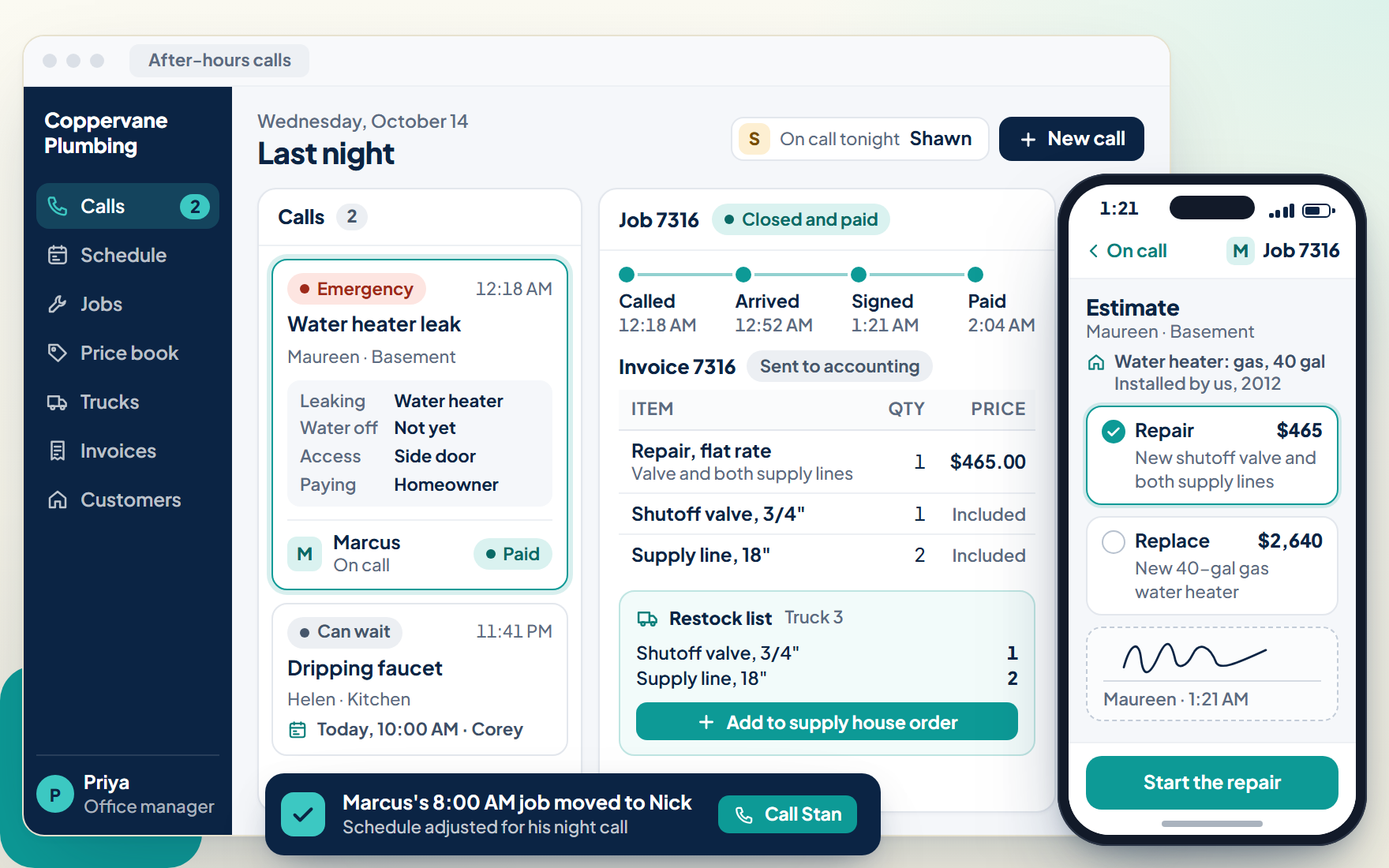
The answering service now asks Coppervane's own questions: what is leaking, whether the water is off, how to get in and who is paying. An emergency goes to the phone of whoever is on call. Everything else waits for the morning schedule.
Marcus's phone shows the address, the customer's past visits, the water heater on file, the access notes and any open balance. He knows what he is driving to before he has his boots on.
In the house he builds the estimate from the price book: a repair and a replacement, each a flat-rate task with labor and parts in the price. The customer picks one and signs on the phone.
The parts he uses come off his truck's count and go onto the invoice. The signed estimate becomes that invoice, the customer pays before he leaves, and the invoice passes to the accounting software the shop already used.
In the morning Priya finds a closed job, a restock list for the truck, and a schedule already adjusted for a plumber who was up late.
The first weeks
The customers and their past visits came over from the scheduling app, and the prices from the binders. Two trucks were still carrying last year's sheet.
The trucks were counted over two Saturdays. Marcus's held six of a valve he rarely used and none of a fitting he would have sworn was there.
In the second week a toilet that wouldn't stop running came through as an emergency and got the on-call plumber out of bed. Owen reworded the question about shutting the water off.
Marcus missed the pad. He kept using the phone, because the estimate reached the office before he did.
A day now
On a night in October the answering service took two calls. A dripping faucet went on the morning schedule, and nobody's phone rang. A water heater leaking in a basement went to Marcus.
His phone showed a heater the shop had put in fourteen years before and a note to use the side door. He priced a repair and a new heater from the price book, and the customer chose the repair and signed. He changed the valve and both supply lines, she paid, and he drove home.
Priya came in at seven. The job was closed and paid, with the valve and the lines on the invoice. Marcus's first appointment had been moved to another plumber. She made one call, to that customer.
The restock list for his truck had a valve and two supply lines on it. She added them to the supply house order.
PlankByte
Case study
Custom software for small businesses.
plankbyte.com/case-studies/plumbing-after-hours-calls/
Contact: plankbyte.com/contact/