Case study
A pool service's routes, moved out of the technicians' heads and notebooks and onto their phones
Clarasombra Pool Care has five route technicians and about four hundred pools a week. Only the technician who drove a route knew its order, its gate codes and its dogs. The story follows the morning one of them called in sick, and the route app that later put the codes, the readings and the extras where the whole company could find them.
- Company
- Clarasombra Pool Care Weekly pool cleaning and repair
- Industry
- Pool service companies
- Location
- Southern Nevada
- Size
- 10 employees, about 400 pools a week
Before and after
What the software changes
-
Before A sick day means rebuilding a route from memory and a notebook of gate codes
After The office splits the route, and the stops open on another technician's phone in order, with the gate code on each
-
Before Chemical readings go on a card in the truck
After Chlorine, pH and alkalinity are entered at the pool, and the app works out a dose
-
Before A customer says nobody came on Tuesday, and the office has only the technician's word
After The customer gets a visit email with the readings and a photo when the stop is closed
-
Before Extra acid or a filter clean never reaches the bill
After Extras recorded at the pool go onto that customer's month and onto the invoice
The story
The business
Clarasombra Pool Care cleans and repairs pools in southern Nevada. Inés, the owner, started with a route of forty pools that she bought from a man who was retiring. Today Bruno and four other route technicians look after about four hundred pools a week, nearly all in backyards and a few at apartment complexes, and Kim manages the office.
Each technician used to leave the yard with a printed route sheet, a test kit and a notebook of gate codes that stayed in the truck. Readings went in pencil on a card for each pool. At month end Kim made up the invoices from the route sheets and whatever had been written in their margins.
The problem
On a Wednesday in late July, one of the technicians called Kim at a quarter past five, too sick to drive. His sixteen pools were on a sheet. The order he drove them in was in his head, and half the gate codes in his notebook were crossed out and written over.
Inés took half the route herself and gave the rest to Bruno, on top of his own. At his third extra pool the code he had copied from the notebook did not open the community gate. Kim called the sick technician, and nobody answered. Bruno waited for a resident to drive in and followed the car through. Two stops later a dog nobody had mentioned met him at the side gate, and he left that pool for the next day.
Back in the office, a customer called to say nobody had come on Tuesday. The technician on that route said he had. All Kim could show her was a check mark on a route sheet.
What decided Inés came at month end. Watching Kim make up the invoices, she remembered pouring extra acid into one pool that Wednesday and cleaning a filter at another. Neither was on a sheet. She had not written them down herself.
She did not want to change how she priced her service. She wanted what a technician knew at each gate to be somewhere other than that technician's head, and what was done at each pool to reach the office the same day.
What was built
PlankByte built a route app that carries a route day from the first gate to the month-end invoice.
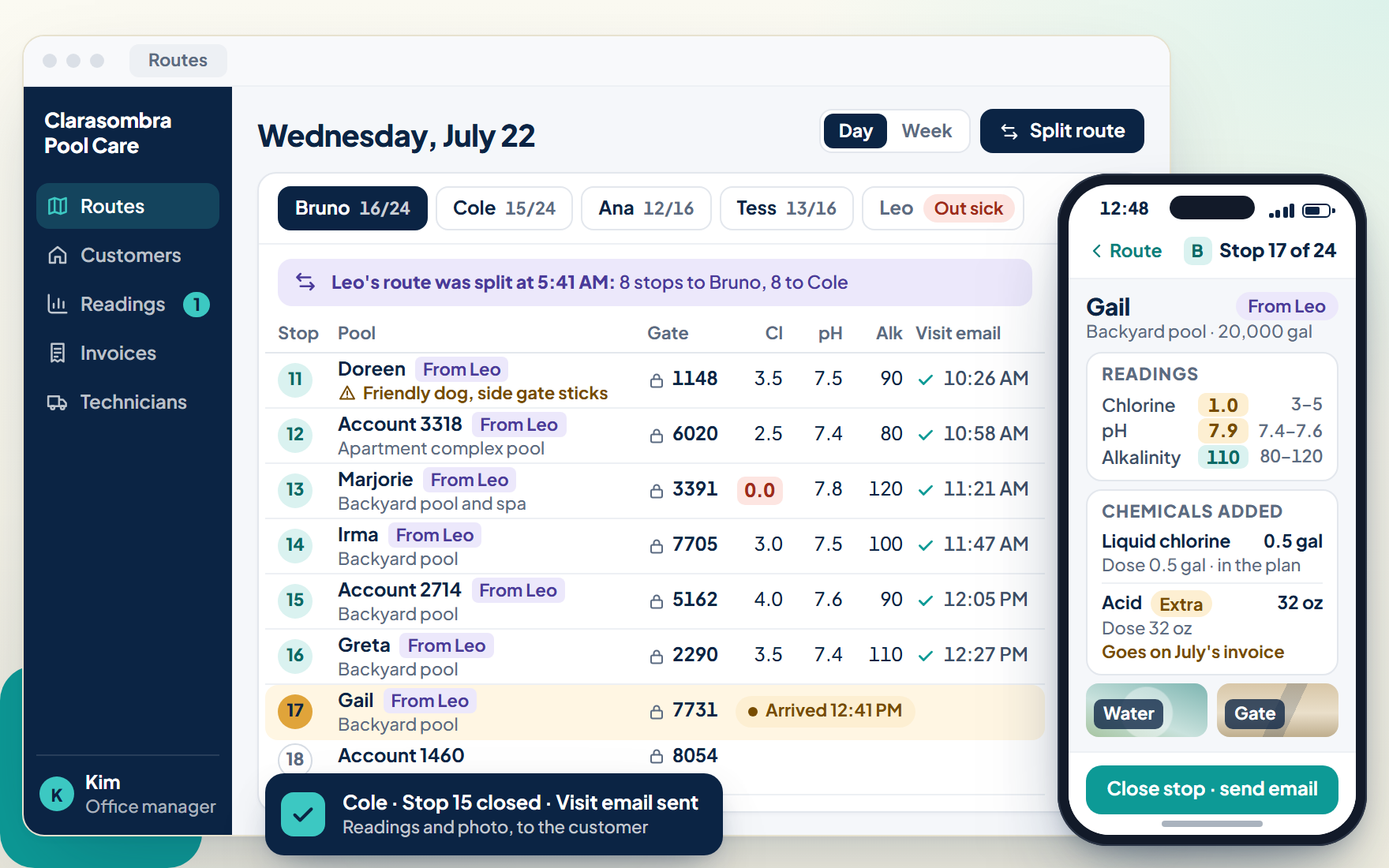
Each morning Bruno opens the day's route on his phone. The stops are in the order he drives them, and each shows its gate code, any pets and the notes from the last visit. When a technician is out, Kim splits the route, and the stops turn up on the other technicians' phones.
At a pool, Bruno enters the chlorine, pH and alkalinity readings, and the app works out a dose from the pool's gallons and the ranges Inés set. He records what he actually added, takes a photo and closes the stop. A reading far outside the range is flagged for Kim.
The customer then gets an email with the readings and the photo: clear water and a latched gate.
Extra acid, a bag of salt or a filter clean is recorded at the pool and goes onto that customer's month. At month end the invoices go out to the customers and over to the accounting software the company already used.
The first weeks
Inés picked January for the change, when the water is cold and a pool asks for the least. Customers, service days and rates came over from the accounting software and the route sheets. The gate codes came out of five notebooks, read aloud to Kim while she typed. Some turned out to be written nowhere at all.
The gallons were harder. For most pools nobody had ever put the size on paper, so Inés spent the slow weeks riding along with a tape measure. Until she was done, Bruno went by his own eye instead of the dose on the screen.
The first visit emails brought calls, most of them from customers asking what alkalinity was. Kim kept a short answer by the phone.
A day now
On a Wednesday the following July, a technician called in sick again.
Kim split his route before the trucks left the yard, and the stops showed up in order on two other phones.
Bruno pulled up to a community gate he had never been through, read the code off the stop and drove in. The note on the next one said the dog was friendly and the side gate stuck. Both were true.
Nobody called the office to ask whether a technician had come. The emails had gone out stop by stop, each with its readings and its photo.
At the last pool on the sick man's route, Bruno added acid beyond the plan, recorded it and latched the gate. It was on that customer's invoice when the month closed.
PlankByte
Case study
Custom software for small businesses.
plankbyte.com/case-studies/pool-services-route-day/
Contact: plankbyte.com/contact/