Case study
A property manager's repair requests, from a lost late-night text to a record everyone can follow
Fernstoop Property Management looks after about three hundred rental units for forty owners. Repair requests reached it by text message, and one that was sent late on a Friday night could not be found on Monday. This is the story of that leak, and of the tenant portal and request tracking that replaced the text messages.
- Company
- Fernstoop Property Management Management of small apartment buildings and single-family rentals
- Industry
- Property management companies
- Location
- Central Ohio
- Size
- 11 employees, about 300 units for 40 owners
Before and after
What the software changes
-
Before A tenant texts the manager's cell about a leak late at night, and by Monday nobody can find the message
After The tenant reports it in the portal with a photo, and it reaches the office marked urgent
-
Before Work goes to whichever vendor someone remembers
After The coordinator sees which vendors cover that trade at that address and assigns one
-
Before The plumber says the job is done, and the tenant says nobody came
After The vendor closes the job with an after photo and an invoice, and the tenant follows each step
-
Before Owners call every month to ask what was spent and why
After The repair and its cost are on the owner's next statement
The story
The business
Fernstoop Property Management looks after about three hundred rental units in central Ohio: small apartment buildings and single-family houses that belong to some forty owners. Naomi, who owns the company, started it with a few houses. Eleven people work there now, among them Sam, the maintenance coordinator.
The books were in accounting software the office trusted. Everything else ran on phones. Tenants sent repair requests to whatever number they had, and many had Naomi's cell from the day she showed them the unit. Sam kept his vendors in a notebook and in his memory. Once a month each owner got a statement, and many of them called about it.
The problem
Late on a Friday night in February, Imani, a tenant in one of the apartment buildings, texted Naomi's cell. Water was dripping under her kitchen sink, and she had put a bowl under the pipe. Naomi read the text in bed and meant to pass it to Sam in the morning.
On Monday Imani called the office to ask when someone was coming. Sam had never heard of the leak. Naomi scrolled back through a weekend of texts from tenants, owners and vendors and could not find hers. Imani described the drip a second time.
Sam called the first plumber who came to mind, not the one who knew that building. That afternoon the plumber texted that the job was done. That evening Imani called again: the pipe was still dripping, and as far as she could tell nobody had come. Sam had one person's word against the other's, and no photo or invoice to settle it. It took a second plumber to stop the drip.
At the end of the month the building's owner called to ask why one dripping pipe had needed two plumbers. Naomi had to ask Sam, and Sam had to call them both.
Naomi did not want new books. The accounting software did its job. What she wanted was her cell phone out of the middle: one place where a request arrived and stayed, and where the tenant, the vendor and the owner could each follow it without calling the office.
What was built
PlankByte built a tenant portal and maintenance tracking that carry each request from the tenant's report to the owner's statement.
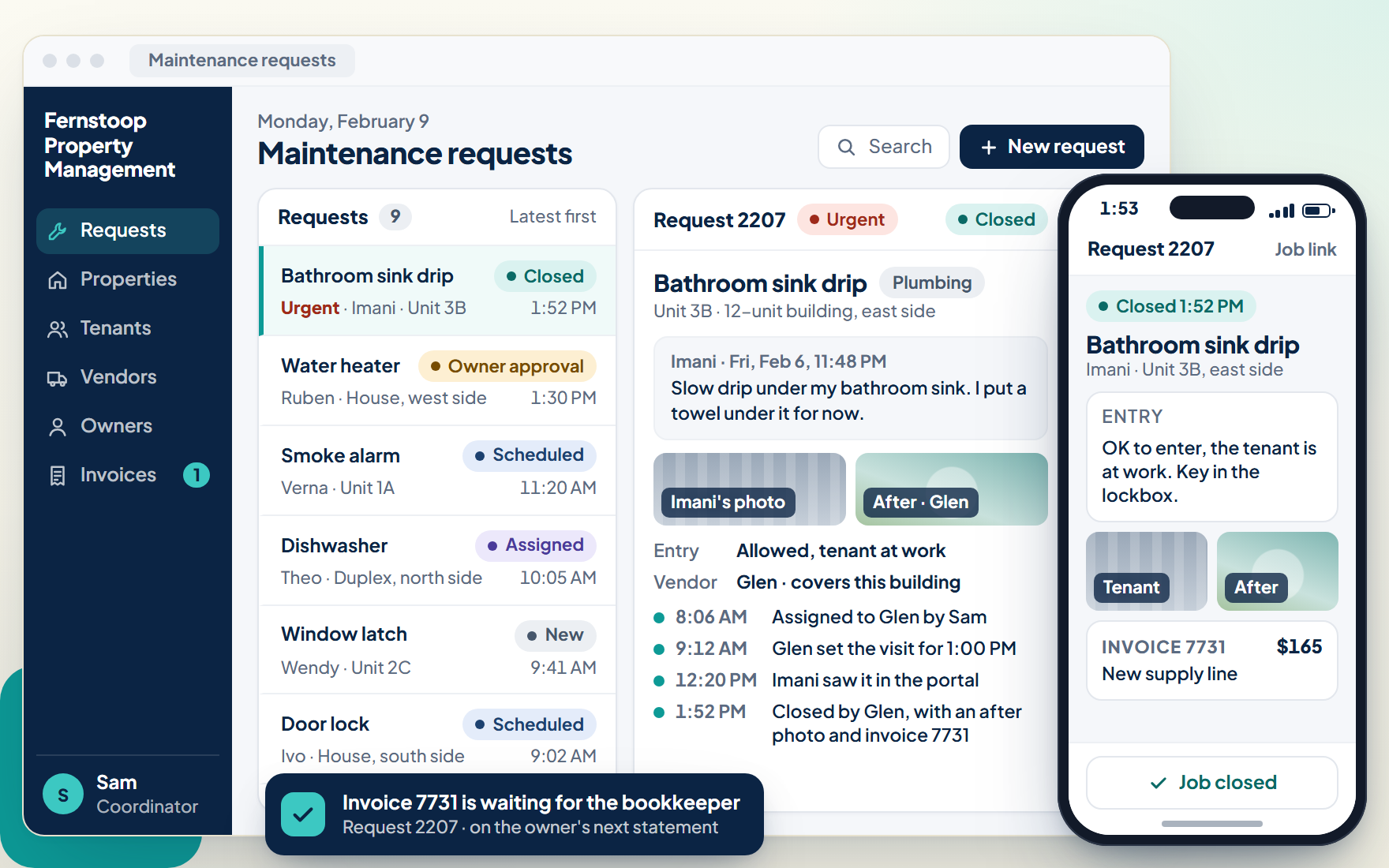
Imani opens the portal on her phone, describes the problem and adds a photo. She says whether a vendor may come in when nobody is home. A leak reaches the office marked urgent.
Sam opens the request and sees which vendors handle plumbing at that address. He assigns one. The plumber gets a link on his phone, with no account to log into. It shows the unit, the entry instructions and Imani's photo. He schedules the visit, and when the work is finished he closes the job with a photo of the repair and his invoice.
If a repair would cost more than the amount set in the owner's management agreement, it waits until the owner approves it.
Imani watches each step in the portal. The owner can look up the same request in a portal of her own, and the repair and its cost are on her next statement. The plumber's invoice is waiting for the bookkeeper, and the books stay where they were.
The first weeks
The office switched in the autumn. The vendors came out of Sam's notebook: for each one he wrote down a trade and the buildings they covered. Naomi read forty management agreements for the amount above which each owner wanted to be asked.
Every tenant got a letter with the portal's address. For a month plenty of them texted Naomi's cell anyway, and she answered each one with that address.
One plumber did much the same to Sam, texting that a job was done instead of closing it from the link. Sam sent him back to the link each time. By the third job the texts had stopped.
A day now
Late on a Friday night the next February, Imani found a slow drip under her bathroom sink. She put a towel under it, opened the portal, described the drip, added a photo and marked that the plumber could come in while she was at work.
On Monday morning the request was at the top of Sam's list, marked urgent, in her own words. He assigned it to the plumber who covered her building.
The plumber scheduled the visit for one o'clock, and Imani saw it in the portal on her lunch break. By two the job was closed, with a photo of a new supply line and an invoice.
Naomi first saw the request that afternoon, already closed.
That month's statement to the building's owner had one more line on it: a supply line replaced under a bathroom sink, and what it cost.
PlankByte
Case study
Custom software for small businesses.
plankbyte.com/case-studies/property-management-maintenance-requests/
Contact: plankbyte.com/contact/