Case study
Every change to a kitchen or bath remodel priced, signed and on the timeline before it is built
Hearthwick Remodeling is a kitchen and bath remodeler with eight to ten jobs open at a time. Its changes were agreed on site, by word or by text, and came up again when the bill went out. After an argument over a shower niche that nobody wrote down, the change order comes first and the work after.
- Company
- Hearthwick Remodeling Kitchen and bath remodeling
- Industry
- Remodeling companies
- Location
- Southern Minnesota
- Size
- 18 employees, 8 to 10 jobs at a time
Before and after
What the software changes
-
Before A change is agreed on site with whoever is working that day, and argued about when the bill comes
After The project manager writes a change order on a tablet, and the client signs it on a phone before the work starts
-
Before Nobody knows what a change does to the schedule until a trade shows up on the wrong day
After The change order shows the days it adds, and the later dates move on the timeline for the trades and the client
-
Before Mornings start with texts asking who is coming today
After The client follows the timeline on a page of their own
-
Before A change that was built is forgotten when the bill is written
After Its amount is added to the next progress payment
The story
The business
Hearthwick Remodeling does kitchens and bathrooms in southern Minnesota. Karen, the owner, has eighteen people working for her and eight to ten jobs open at a time, each inside a house where a family is still living.
Karen wrote every quote from a price list in a spreadsheet, and she wrote every bill. Jamal, the project manager, kept the schedules in a notebook and in a text thread for each job. A change was agreed wherever it came up, usually in a doorway, between the client and whoever was working that day.
The problem
On a Thursday in October, Karen and a client, Lena, argued on the phone about a shower niche. It was a line on the final bill for Lena's upstairs bathroom. Lena had asked the tile setter for it while he was laying out the wall, he had told her it was no trouble, and nobody had mentioned a price. Karen had nothing on paper to answer with.
She called Jamal, who was in his truck answering the morning's texts from clients asking who was coming that day and when the dust would be gone. He remembered the niche. It had added two days to the tile. Nobody had told the glass installer, who came to measure for the shower door on the day he was booked, found the tile still going up, and couldn't come back for a week.
Karen took the niche off the bill. She didn't think Lena was wrong. Lena's kitchen was booked for the spring, and Karen didn't want it to start with a grudge.
That night she went back through months of texts and found a light that an electrician had added over a vanity in August, at a client's request. Hearthwick had paid him and never billed it.
She didn't want new software for the whole company. The quotes and the accounting worked. She wanted one rule she could hold everyone to: no change gets built until the client has seen its price and its days, and has signed.
What was built
PlankByte built a change order that the client signs before the work starts, tied to the job's timeline and its progress payments.
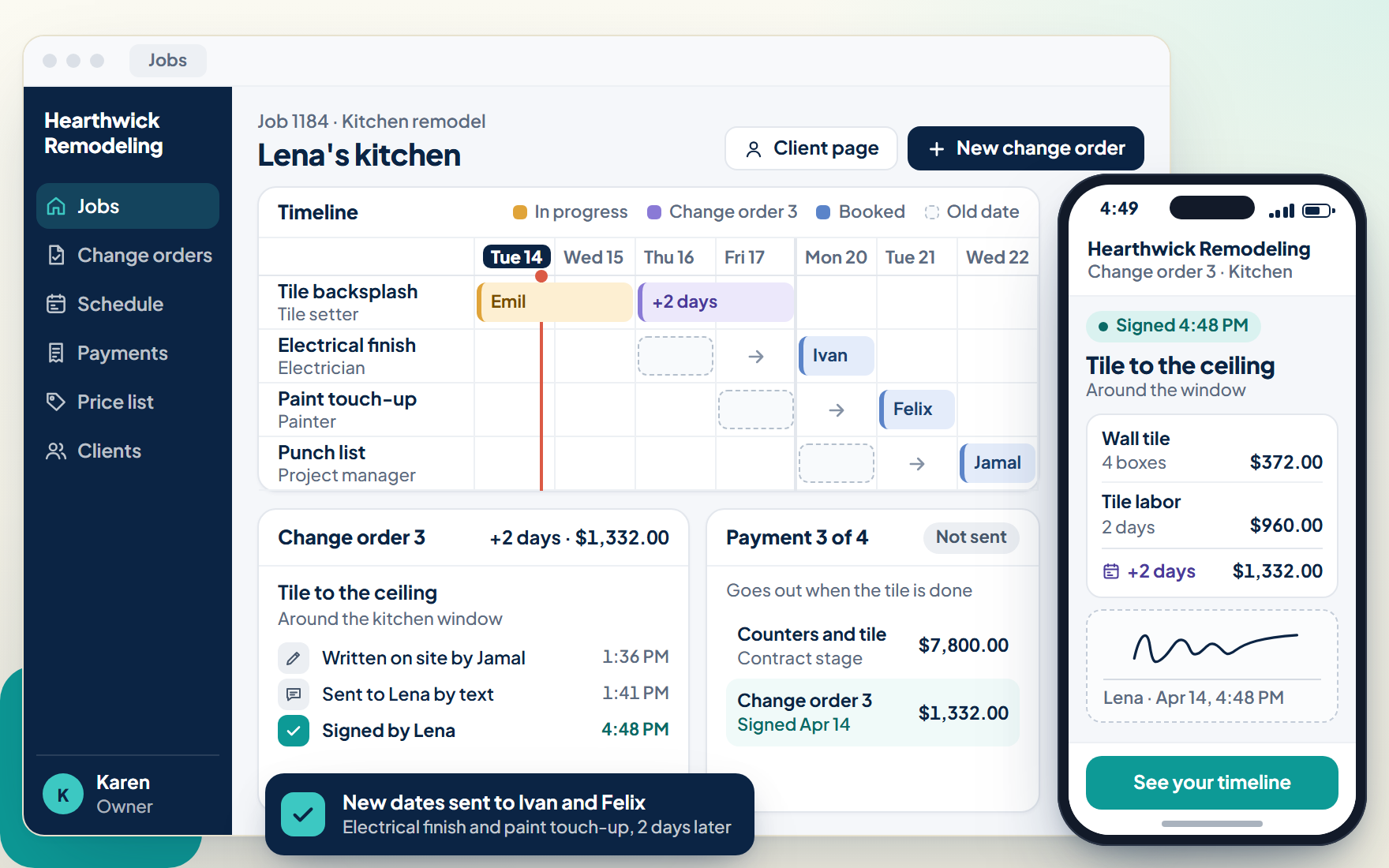
When a client asks for something that isn't in the contract, whoever hears it calls Jamal. He opens a change order on his tablet, on site, and adds the labor and the materials. The prices come from the same list Karen's quotes use, and the change order shows how many days it adds.
The client gets a link by text or email, reads the change order on a phone and signs there. The signed copy is saved with the job, with its date. The crew doesn't start before that.
Once it is signed, the later dates move on the job's timeline, and the trades booked on those steps see their new dates. The amount is added to the next progress payment, so it is on the payment request when Karen sends it.
Each client has a page of their own, with the timeline and who is booked on each step.
The first weeks
Hearthwick started using the software in January, on the jobs it already had open. Karen's price list came over from her spreadsheet. Jamal went through his notebook and put each job's steps, dates and trades on a timeline.
The price list turned out to be written for whole rooms. It had no line for a niche, or for one more light, so for the first few change orders Jamal had to call Karen for a price. She added lines as they came up.
The harder part was on site. The tile setter had spent twenty years saying yes to homeowners, and now he had to say that Jamal would write it up. It took him until spring to say it without apologizing.
A day now
In April the tile setter was back at Lena's house, laying out the kitchen backsplash. Lena asked him whether the tile could run up the wall around the window, to the ceiling. He told her it could, and that Jamal would write it up.
Jamal came by after lunch and opened a change order on the tablet: more tile, more labor, two more days. Lena read it on her phone at work and signed before she drove home.
The electrician's finish work and the painter's touch-up each moved two days on the timeline, and both saw their new dates the same day. That evening, on her page, Lena could see who was coming for the rest of the week.
When the tile was done, Karen sent the next payment request. The extra tile was already a line on it, with the date Lena had signed.
PlankByte
Case study
Custom software for small businesses.
plankbyte.com/case-studies/remodeling-change-orders/
Contact: plankbyte.com/contact/