Case study
One stock count, not three, for a clothing shop that sells in the store and online
Scree & Spruce Outfitters is an outdoor clothing shop with one store, a web store and a marketplace listing. Each of the three kept its own stock count, and one Saturday the last jacket in a size sold twice. Here is that Saturday, and the one count all three places share today.
- Company
- Scree & Spruce Outfitters Outdoor clothing shop with a web store and a marketplace listing
- Industry
- Retail businesses
- Location
- Western Montana
- Size
- 8 employees, 1 store
Before and after
What the software changes
-
Before The last one sells at the register at lunch and again online that afternoon
After A sale at the register takes that size and color out of stock in the web store and on the marketplace listing
-
Before Every new product is typed in three times
After A product is entered once and goes to the register, the web store and the marketplace listing
-
Before Reordering means walking the floor with a notepad
After An item below its reorder point appears on a draft order for its supplier
-
Before The month's numbers come from three exports pasted into one spreadsheet
After The day's sales from every channel are in one report, each with its margin
The story
The business
Scree & Spruce Outfitters is an outdoor clothing shop in western Montana: one store, eight people, and walls of jackets, base layers and wool socks. Hannah owns it and still does the buying. Ty manages the store. Olivia packs the web orders in the back room.
The shop sells at the register, in its web store and through a marketplace listing. For years each kept its own stock count. Every new style was typed in three times. Ty reordered by walking the floor with a notepad, and each month Hannah pasted three exports into one spreadsheet.
The problem
A little after noon on a Saturday in October, Ty sold the last medium in a blue down jacket to a man who wore it out of the store. The register took one off its count. The web store and the marketplace listing each still showed one left.
Just before four, a web order came in for the same jacket in the same size. Olivia searched the jacket wall and the back room before she asked Ty, who remembered the man.
She canceled the order and wrote to the customer to apologize. The customer answered that she had wanted the jacket for a trip the next weekend and would look somewhere else.
Olivia spent the rest of the afternoon at the jacket wall, checking each size against the web store and the listing. Two more were wrong. The blue jacket wasn't on Ty's reorder notes from that morning: at nine there had still been one.
It was not the first apology of the fall. That evening Hannah decided she was done counting in three places. She didn't want a new register or a new web store; each did its job. She wanted one count that all three agreed on, and to type a new style once.
What was built
PlankByte built one stock count for the shop, shared by the register, the web store and the marketplace listing.
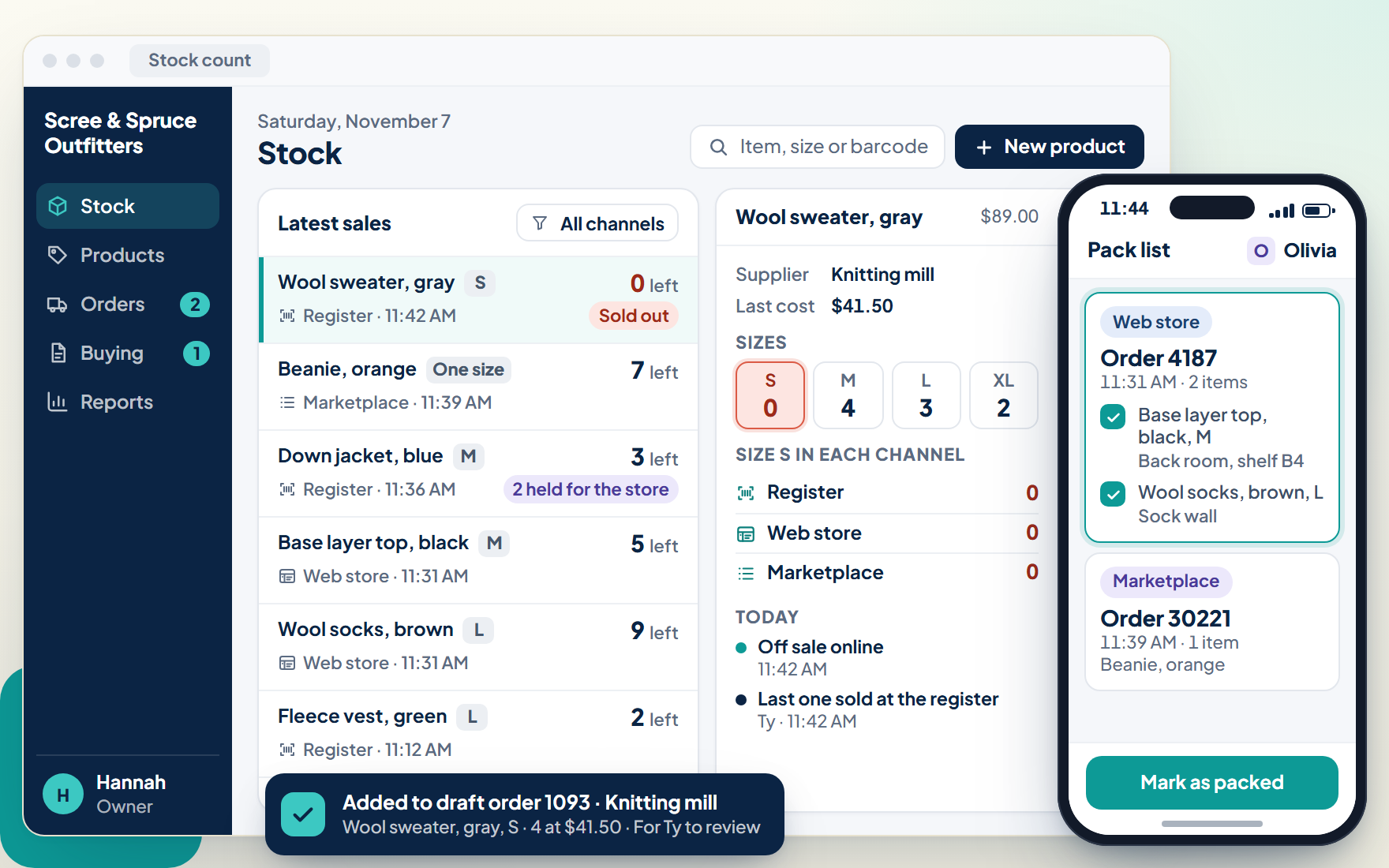
Every size and color of every item has its own count. When Ty rings up the last medium in a jacket, that size shows zero in the web store and on the listing moments later, and it stops selling online. Hannah holds a few units of the fastest sellers back from the online channels, so a busy Saturday or a late update doesn't sell one twice.
A new product is entered once, with its sizes, colors, photos, barcode and price, and goes from there to the register, the web store and the listing. Olivia picks, packs and ships from one list of web and marketplace orders.
When an item falls below its reorder point, it appears on a draft order for its supplier, at the last cost the shop paid. Ty reads the draft over, and Hannah sends it.
Each evening one report shows the day's sales from all three places, each sale with its margin, and the day's totals go to the accounting software the shop already used.
The first weeks
The product list came first. The same jacket had one name and number at the register, another in the web store and a third on the marketplace listing. Olivia and Ty matched them up on slow mornings.
Then, on a Sunday with the door locked, all eight of them counted the store piece by piece, and that became the starting count.
One habit was hard to break. When a hang tag wouldn't scan, the floor staff had always rung the item up as miscellaneous clothing, and a sale like that lowered no count. Ty taped a note to the register. The reorder points took a second try: the first draft order asked for sun hats with snow on the ground, so Hannah reset them from what had actually sold.
A day now
On a Saturday the following fall, Ty sold the last small in a gray wool sweater just before lunch. By the time the customer was out the door, that size showed zero in the web store and on the marketplace listing. Nobody ordered it that afternoon, because nobody could.
Olivia packed the day's orders from her one list, and every item on it was where it should be.
The sweater was now below its reorder point, and already on the draft order for its supplier. Nobody had walked the floor to put it there.
That evening Hannah read the day's report: register, web store and marketplace listing side by side, each sale with its margin. Then she turned the sign in the door and locked up.
PlankByte
Case study
Custom software for small businesses.
plankbyte.com/case-studies/retail-inventory-across-channels/
Contact: plankbyte.com/contact/