Case study
From paper timesheets to one set of approved hours for a staffing agency's payroll and invoices
Lunchpail Staffing is a light-industrial staffing agency that places about 250 workers a week. Its shifts were filled from text messages, and its hours came in on paper and were typed twice. This is the story of the Tuesday when all of that went wrong at once, and of the one set of approved hours that replaced it.
- Company
- Lunchpail Staffing Light-industrial staffing
- Industry
- Staffing agencies
- Location
- Inland Southern California
- Size
- 16 office staff, about 250 workers placed a week
Before and after
What the software changes
-
Before A dawn call for forklift drivers means scrolling through text messages to see who is free and certified
After The recruiter sees who is available, certified and nearby, and offers the shift by text
-
Before Supervisors sign paper timesheets on Friday, and the office reads handwriting on Monday
After Workers clock in on site, and the client's supervisor reviews and approves the week online
-
Before Payroll and the client's invoice are typed separately and don't always match
After The approved hours go out as the payroll file and as the invoice
-
Before An expired forklift card is discovered by the client
After Each credential has its expiry date on file, and an order's list shows only workers who are certified for it
The story
The business
Lunchpail Staffing is a light-industrial staffing agency in inland Southern California. Its office of sixteen places about 250 workers a week with some thirty clients, mostly warehouses and packing plants. Monique manages the branch. Arturo is one of its recruiters, and Lin is its payroll specialist.
Applicants were kept in an applicant tracking system, and payroll went to a payroll provider. Everything in between ran on text messages and paper. Copies of forklift cards were in a folder in Monique's office. Hours came in on paper timesheets that each client's supervisor signed on Friday.
The problem
On a Tuesday in October, before five in the morning, a warehouse client called Arturo at home. Two containers were coming a day early, and it needed four forklift drivers for second shift. Arturo sat at his kitchen table scrolling through weeks of text messages to see who was free and who was certified to drive a forklift. By nine he had four names.
At three the client's supervisor called Monique. One of the four had handed over a forklift card that had expired in August. The supervisor caught it at the dock and sent him home, and the shift was a driver short. The agency's copy was in the folder, with the date on it. Nobody had looked.
Lin spent that Tuesday on the week before. The timesheets had come in on Monday, and she was still reading handwriting: a seven that might have been a one. She typed the hours into payroll, and the invoices were typed separately from the same sheets. That afternoon a worker called to say his check was a shift short. The client's invoice had that shift on it.
Monique had put up with each of these one at a time. That Tuesday she got all three before dinner. The applicant tracking system and the payroll provider could stay. She wanted a list of who could take a shift, without searching a phone, and one set of hours: entered once, approved by the client, and used for both the paycheck and the invoice.
What was built
PlankByte built one path from a client's order to its approved hours, between the two systems the agency kept.
A client's supervisor enters an order in the client portal. Arturo opens it and sees the workers who are available, certified and close by. Every credential is on file with its expiry date, so an expired forklift card keeps a worker off the list, and Monique sees whose card is about to lapse. Arturo sends the shift to that list by text.
Workers reply to accept or decline. A full shift closes on its own. The night before, each worker gets a reminder, and anyone who hasn't confirmed is flagged for Arturo to call.
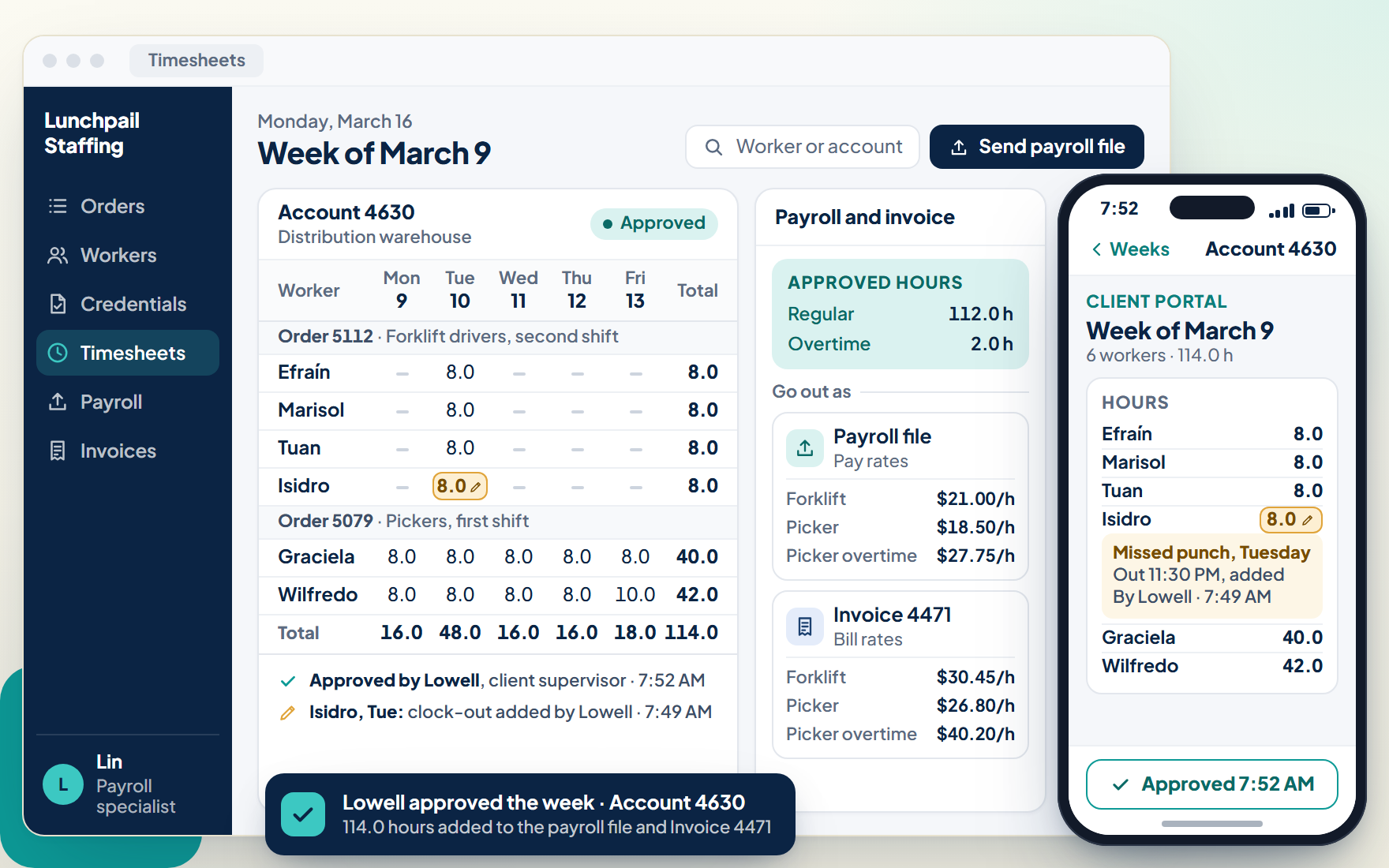
On site, workers clock in and out on their phones. On Monday the client's supervisor reviews the week online, fixes a missed punch and approves. Each change records who made it and when.
Lin no longer types hours. The approved hours, with pay rates, overtime and bill rates applied, go out as a payroll file for the provider the agency already used and as each client's invoice.
The first weeks
The workers' records were entered from the applicant tracking system's own lists. The forklift cards came out of the folder and were entered one by one, each with its date. A few copies were too faint to read, so those workers brought their cards in.
Workers forgot to clock out, and for a while most of what supervisors fixed on Monday was a missing punch.
Arturo took the longest. He kept texting his regulars first, and twice a shift ended up with one driver too many. Monique asked him to send every offer from the order, so the shift could count its own replies.
A day now
On a Tuesday in March the same warehouse needed forklift drivers for second shift. Its supervisor entered the order in the portal before five, and called Arturo anyway.
Arturo opened it at his kitchen table. The list showed eleven workers who were free that afternoon, held a current forklift card and lived near the site. He sent the shift by text. Four drivers accepted, and the shift closed.
That afternoon all four clocked in at the dock. Nobody was sent home.
The next Monday the supervisor reviewed the week online, fixed one missed punch and approved.
Lin sent the payroll file and the invoices that morning. The drivers were paid for the hours the client had approved, and the client was billed for the same ones.
PlankByte
Case study
Custom software for small businesses.
plankbyte.com/case-studies/staffing-approved-hours/
Contact: plankbyte.com/contact/