Case study
A scan at every bin and a count that drops with every shipment, for a one-warehouse distributor
Binrow Fastener & Supply is a fastener and fittings distributor with one warehouse and about four thousand SKUs. It picked from printed lists and kept its stock count in a spreadsheet, until a carton of the wrong thread reached a customer. The scan-to-ship flow in this story puts a scan at every bin and moves the count when an order ships.
- Company
- Binrow Fastener & Supply Distribution of fasteners and fittings from one warehouse
- Industry
- Warehousing and distribution
- Location
- Northern Indiana
- Size
- 22 employees, 1 warehouse
Before and after
What the software changes
-
Before The spreadsheet says there is a full case, and the picker walks to an empty bin
After Stock is reserved when the order comes in and counted down when it ships
-
Before Purchase orders from email, the EDI portal and the web store are keyed in again by hand
After Orders from every channel land in one queue, and nobody retypes them
-
Before Picking runs on printed lists and memory, and a look-alike part can ship
After The picker scans each bin and item, so a wrong item is caught at the shelf
-
Before Customers call to ask where their order is, and someone walks to the pack station to find out
After Tracking goes to the customer when the shipment closes at the pack station
The story
The business
Binrow Fastener & Supply sells fasteners and fittings out of one warehouse in northern Indiana. Twenty-two people work there, and about four thousand SKUs sit on the shelves, from cap screws by the case to brass fittings by the bag.
Orders arrived three ways: small shops used the web store, a hardware chain sent purchase orders through an EDI portal, and older accounts emailed theirs. Omar, in customer service, keyed each one into the accounting software and printed a pick list for Tasha, the lead picker, and her crew. Vic, the operations manager, kept the stock count in a spreadsheet he updated at the end of each day.
The problem
On a Tuesday in March a trailer builder called to say its frame line had stopped. The carton Binrow had sent the day before held three-eighths cap screws in fine thread, and the purchase order said coarse. The two cartons sit in neighboring bins and differ by one number on the label. A picker in his second week had taken the wrong one.
Omar opened the spreadsheet, saw a full case of coarse thread and promised it for the afternoon truck. Tasha walked to the bin and found it empty. The last case had left that morning on a web order, and the count would not catch up until the end of the day.
She found another case an hour later on a top rack two aisles over, where a pallet had been put away and nobody had written down the spot. By then the truck was gone. All afternoon customers called Omar to ask where their orders were, and each answer meant a walk to the pack station to look through the day's shipping receipts.
Vic drove the case to the trailer builder himself that evening. On the way back he decided he was done running the floor on paper and memory. He did not want to replace the accounting software. He wanted a count he could trust, every order in one place, and the wrong carton stopped before it reached a box.
What was built
PlankByte built a scan-to-ship flow for the pickers and the pack station, fed by one order queue.
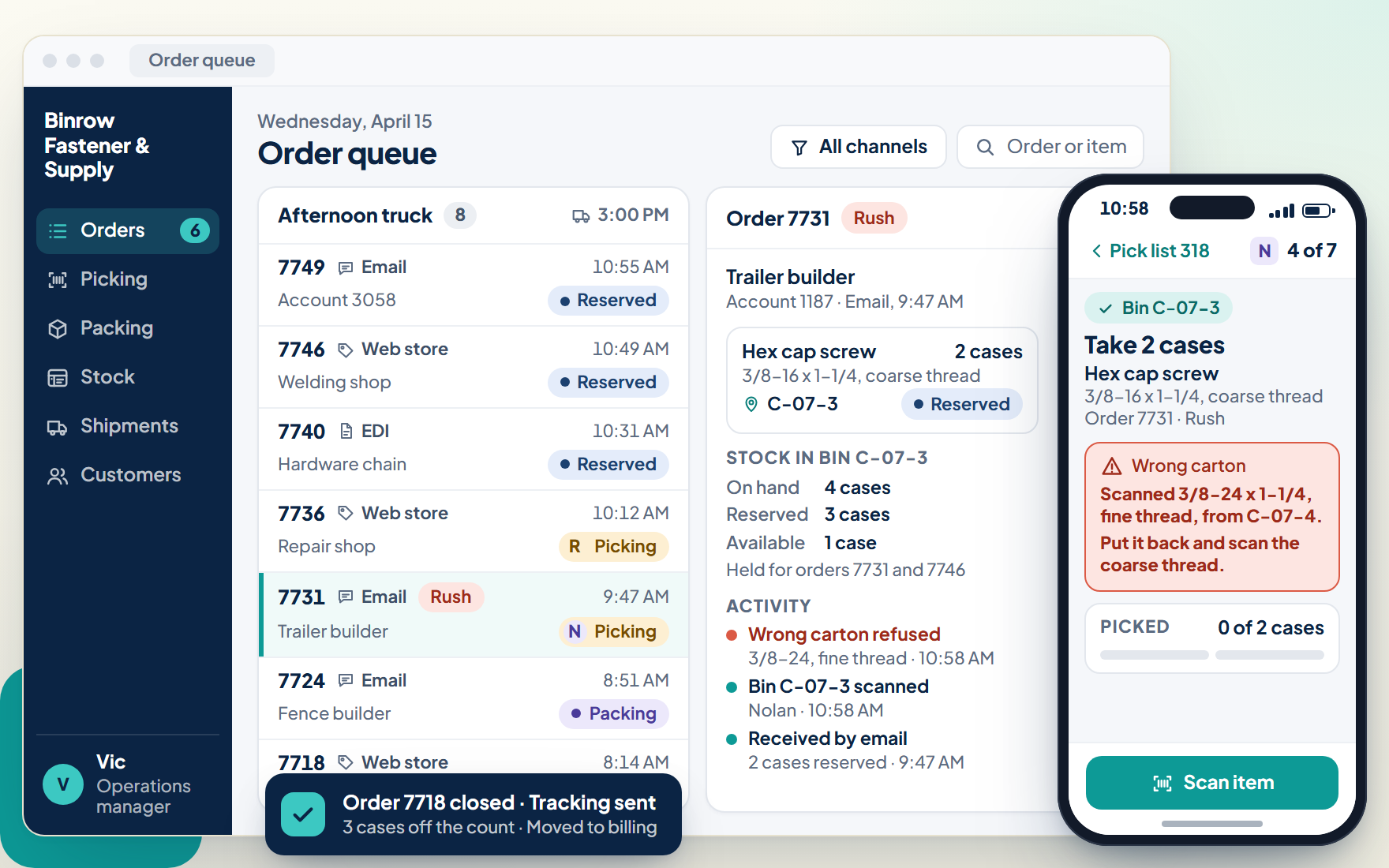
Orders from the web store, the hardware chain's EDI purchase orders and the emailed ones land in that queue, and Omar no longer keys them in. Each order reserves its stock as it arrives, so the last case on a shelf can be promised only once.
Tasha and her pickers carry handheld scanners. A picker opens the next pick list, which runs in aisle order, and scans each bin and then the item. If the carton holds fine thread and the order says coarse, the scanner says so at the shelf.
At the pack station the order is checked once more. The packer weighs the box and enters its size once, and the packing slip and the carrier label print together. Closing the shipment sends tracking to the customer, takes the cases off the count and moves the order on to billing.
Vic opens the same queue to see what is still waiting before the afternoon truck.
The first weeks
The warehouse changed over on a long weekend. The item list came across from the spreadsheet. The counts did not. Every bin got a barcode label, and Tasha's crew counted the building bin by bin with the scanners, so the new count began with what was on the shelves.
The first pick lists took the aisles in numbered order. The building is not walked that way: the heavy cases go on the cart first. Tasha walked a list with a scanner in her hand, and the order was changed to match her route.
Scanning the bin before reaching into it took longer to become a habit. Pickers who knew the shelves by heart grabbed the carton first and then had to go back for the bin.
A day now
The following spring the trailer builder emailed a rush order for the same coarse-thread cap screws. It landed in the queue with two cases reserved. A web order for those screws came in an hour later and was checked against what was left, not against the two cases already spoken for.
On the floor a picker scanned the bin, reached one bin too far and scanned a carton of fine thread. The scanner refused it. He put it back and took the right one.
At the pack station the box was checked, weighed and labeled, and the trailer builder had a tracking number before the truck backed up to the dock. Nobody called Omar to ask where the order was. Tasha spent that hour receiving a pallet.
Vic was at his desk when the afternoon truck pulled out. Two cases of coarse thread were on it, and the count for that bin was two cases lower.
PlankByte
Case study
Custom software for small businesses.
plankbyte.com/case-studies/warehousing-scan-to-ship/
Contact: plankbyte.com/contact/