Case study
A wholesaler's late-night restaurant orders reach the warehouse without anyone retyping them
Dockside Larder Foodservice supplies about three hundred restaurants from one warehouse. Their orders came in overnight by phone, email, fax and text, and one person typed them all before a truck could be loaded. After a Friday in Lent when that went wrong, the restaurants got a portal where they place their own orders, with their own prices and the stock in front of them.
- Company
- Dockside Larder Foodservice Foodservice wholesale to restaurants
- Industry
- Wholesale businesses
- Location
- Southern Louisiana
- Size
- 65 employees, 1 warehouse, about 300 restaurants
Before and after
What the software changes
-
Before Orders arrive by phone, email, fax and text, and someone retypes them all
After Customers reorder in the portal, starting from their last order
-
Before Each big account's current prices are in one sales rep's spreadsheet
After The portal shows each customer their own prices, from the same rules the invoice uses
-
Before Customers call all day to ask whether an item is in stock
After Stock is shown as they order, with a substitute suggested for an item that ran out
-
Before An order ships to an account that is well past its terms
After The order passes a credit check before it reaches the warehouse
The story
The business
Dockside Larder Foodservice sells food and kitchen supplies to about three hundred restaurants in southern Louisiana, all from one warehouse. Angela, the owner, employs sixty-five people, and her trucks leave the dock at seven every morning.
Restaurants order after they close. For years that meant a voicemail, an email, a fax, or a text to a sales rep. Phuong, in inside sales, came in at four to type every order into the accounting software, which printed pick tickets for Darnell, the warehouse manager. When a customer called about stock, somebody walked the freezer to look. Each big account had its own prices, and the only current copy was in a rep's spreadsheet.
The problem
At four in the morning on the second Friday of Lent, Phuong opened the office and found the night's orders in four places: the voicemail, the inbox, the fax tray, and a string of texts a rep had forwarded as pictures. In one voicemail a cook read his list over a running dish machine. She typed all of it, and the pickers started late.
A seafood restaurant had ordered twelve cases of catfish fillets for its Friday fish fry. The picker found six in the slot, and the restaurant found out when the truck arrived short. Darnell found another pack in the freezer that would do, and Angela drove six cases over in her own car.
While she was gone, a restaurant group called about its invoice. Its rep had agreed to a new shrimp price in January, but the deal was only in his spreadsheet, and the invoice went out at the old price.
That afternoon Angela learned that a full order had gone to a restaurant that had paid nothing since Christmas. Nobody had checked its balance.
That evening Angela made up her mind. She didn't want new accounting software. Hers kept the items, customers and invoices well enough. She wanted orders to arrive already typed, at the price each customer had been promised, with the stock and the account checked before a truck was loaded.
What was built
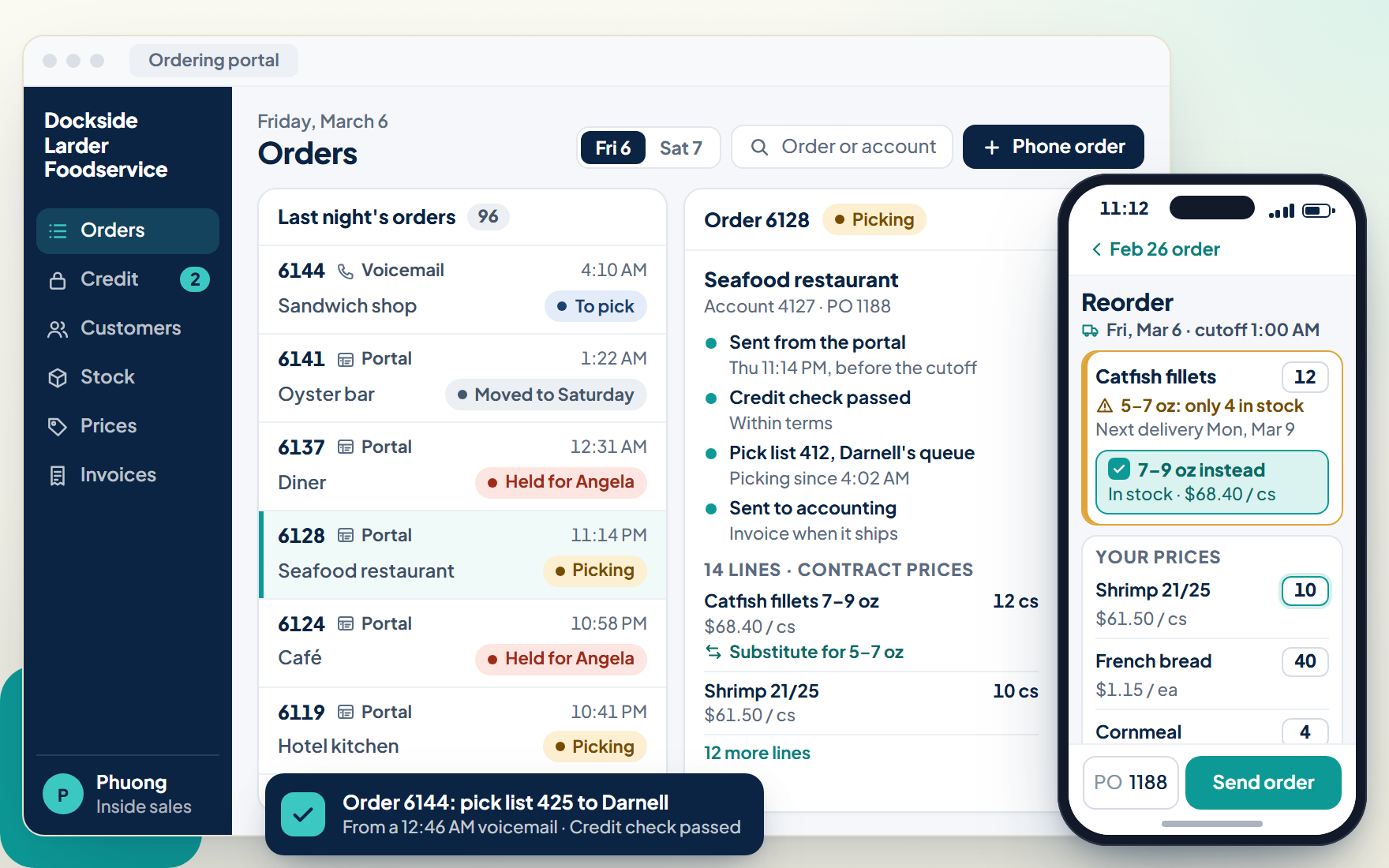
PlankByte built an ordering portal for Dockside Larder's customers.
A restaurant owner logs in after closing, opens last week's order, changes a few quantities, adds a PO number and sends it before the cutoff for the morning truck. An order sent after the cutoff moves to the next delivery day.
The prices on the screen are that customer's own, by the case or by the each. They come from one set of rules, which the invoice uses too, and no longer from a rep's spreadsheet.
As the customer orders, the portal shows what is in stock and when the vendor's next delivery is due. If an item has run out, it suggests a substitute or offers a backorder before the order is confirmed.
Every order then passes a credit check. One from an account past its terms waits until Angela releases it. The rest reach Darnell's queue as pick lists and go into the accounting software the company already used. When an order ships, the invoice appears in the customer's account.
Some customers still call. Phuong enters their orders in the same system, so the warehouse works from one queue.
The first weeks
The first customers on the portal were a dozen restaurants that already ordered late at night. The items and the customers came over from the accounting software. The prices took longer: a few deals were in no spreadsheet, only in a rep's head, and Angela called those customers to settle each one.
Darnell and Phuong chose the substitutes: which fillet could stand in for which.
In the second week the portal offered a customer two cases of crab meat that were not on the shelf. The count on file was wrong. After that, Darnell's crew counted the fast sellers every afternoon.
A day now
On a Thursday night in Lent the next year, the owner of a seafood restaurant locked up and opened last week's order. The portal showed catfish fillets short until the vendor's Monday delivery and offered another pack. He took it, raised the shrimp to ten cases and sent the order before the cutoff.
Phuong opened the office at four. Most of the night's orders were already in Darnell's queue, and the pickers started on time. She played six voicemails and entered those orders herself. The fax tray held one page.
Two orders were waiting for Angela, both from accounts past their terms. She released one after a phone call and left the other where it was.
The trucks pulled out at seven. Angela's car stayed in the lot.
PlankByte
Case study
Custom software for small businesses.
plankbyte.com/case-studies/wholesale-ordering-portal/
Contact: plankbyte.com/contact/